• Home
    • All products
    • Grade 0
    • Grade 1
    • Grade 2
    • Grade 3
    • Grade 4
    • Grade 5
    • Markku Viitasaari
    • Jukka Viitasaari
    • Big Band
    • SPOL
    • 7ikko/Edition 7
    • Brass Septet
    • Ilari Hylkilä
    • With soloist(s)
    • Fennica Gehrman
    • Pink Baton Productions
      • Hanna-Mari Lehtonen
      • Heli Seppälä
    • Hanna-Mari Lehtonen
    • A-MInor Production
    • Antti Nissilä
    • Anita Lehto
    • Jukka-Pekka Lehto
    • Anne Kankare
    • FLEX
    • Brass Band
    • Brass (& Percussion)
    • Heli Seppälä
    • Brass Quintet / vaskikvintetti
    • Boys of America - Finnish Brass in America Series
  • Empty bag
FinnBandShop

FinnBandShop

FinnBandShop – Your Global Source for Finnish Wind Band Sheet Music. Discover, Inspire, Elevate. A collective online store by Finnish wind music publishers.

FinnBandShop – Globaali suomalaisten puhallinorkesterinuottien lähteesi. Suomalaisten puhallinmusiikkikustantajien kollektiivinen verkkokauppa.

Show more
  • finnbandyhdistys@gmail.com
  • https://www.youtube.com/@finnbandpublishers5511

Boys of America - Finnish Brass in America Series

  • Product image of  Aamulla varhain - Early in the Morning

    Aamulla varhain - Early in the Morning

    15.00 EUR

    Ameriikan poijat Finnish Classics Series Aamula varhain (“Early in the morning. A song of lost love.”
) is one of many short descriptive instrumental works by Edvard Armas Järnefelt (14 August 1869 – 23 June 1958). He was a Finnish conductor and composer, who achieved some minor success with such orchestral music Berceuse and Praeludium. He spent much of his conducting career at the Royal Swedish Opera in Stockholm, Sweden. Many of these works have been transcribed for Seitsikko. <pre>All titles have been edited to contain the following parts: </pre> • Standard Finnish septet : E-flat soprano cornet, B-flat cornet I, B-flat cornet II, E-flat alto, B-flat tenor , B-flat baritone, BB-tuba (concert pitch Bass Clef). Our wish is that brass players will try the conical brass instrumentation, but also welcome playing by mixed wind bands. • Additional parts provided: Part 1 in Bb, Part 1 in C, Part 2 in C, Part 3 in C, Part 4 in F, Part 5 in Bb treble, Part 6 in Bb treble, Part 7 in Bb treble (for bass clarinet). This should provide most parts for a standard concert band. Only limited percussion is included, but could be added ad lib. Additional parts in other transpositions can be requested. The Ameriikan poijat Finnish Classics Series is scored primarily for original Finnish brass septet: E flat Soprano Cornet, two B flat Cornets, an E flat Alto Horn, a B flat Tenor Horn, an Euphonium, and a Tuba. However, these sets also include alternate parts for flute (piccolo), clarinet, French horn, and tenor saxophone. The original seven parts can also be played by other instrumentalists who read those clefs and transpositions (tenor saxophone, bassoon, bass clarinet, etc.) While many of us in Ameriikan poijat have contributed arrangements to this series, it has been primarily of work of Tracey Gibbens, with editing by Russell Pesola and Paul Niemisto. Järnefelt was born in Vyborg, in the son of General August Aleksander Järnefelt and Elisabeth Järnefelt (née Clodt von Jürgensburg). Järnefelt studied with Ferruccio Busoni in Helsinki and with Jules Massenet in Paris. Both Järnefelt and Busoni enjoyed a close relationship with Jean Sibelius, who was married to Järnefelt's sister Aino. Between 1932-36 Järnefelt was the artistic director and conductor of the Finnish National Opera. He presented, among others, Siegfried and Götterdämmerung from Wagner's Ring cycle, and Parsifal. He was principal conductor of the Helsinki Philharmonic Orchestra 1942–1943, and also returned to the Royal Swedish Opera as chief conductor from 1938 to 1946. He died in Stockholm.
  • Product image of  Aeroplane March (by Lauri Koski)

    Aeroplane March (by Lauri Koski)

    15.00 EUR

    Aeroplane March was written by Lauri Koski probably while he was a bandmaster in Monessen, Pennsylvania. It was found in manuscript in Fitchburg, Massachusetts and apparently was never published. Nothing specific is known about the title. The Finnish Brass in America Series is scored primarily for original Finnish brass septet: E flat Soprano Cornet, two B flat Cornets, an E flat Alto Horn, a B flat Tenor Horn, an Euphonium, and a Tuba. However, these sets also include alternate parts for flute (piccolo), clarinet, oboe, French horn, and saxophones. The original seven parts can also be played by other instrumentalists who read those clefs and transpositions (tenor saxophone, bassoon, bass clarinet, etc.) <pre>All titles have been edited to contain the following parts: </pre> • Standard Finnish septet : E-flat soprano cornet, B-flat cornet I, B-flat cornet II, E-flat alto, B-flat tenor , B-flat baritone, BB-tuba (concert pitch Bass Clef). Our wish is that brass players will try the conical brass instrumentation, but also welcome playing by mixed wind bands. • Additional parts provided: Part 1 in Bb, Part 1 in C, Part 2 in C, Part 3 in C, Part 4 in F, Part 5 in Bb treble, Part 6 in Bb treble, Part 7 in Bb treble (for bass clarinet). This should provide most parts for a standard concert band. Only limited percussion is included, but could be added ad lib. Additional parts in other transpositions can be requested.

  • Product image of  Gipsy Life Impromptu ala Zingara (by Aatto Lumme)

    Gipsy Life Impromptu ala Zingara (by Aatto Lumme)

    15.00 EUR

    Aatto A. Liljeström was a Finnish military band conductor and composer. He used the Finnish name A. A. Lumme as was the custom of the time. He served in several leadership roles around Finland during his career, especially in Tampere and Savonlinna. After independence in June 1918, Lilijeström was appointed the first chief conductor of the new Finnish army bands. Impromptu is one of many works he wrote for brass band and was published by the Sibelius Club in Monessen, PA. <pre>All titles have been edited to contain the following parts: </pre> • Standard Finnish septet : E-flat soprano cornet, B-flat cornet I, B-flat cornet II, E-flat alto, B-flat tenor , B-flat baritone, BB-tuba (concert pitch Bass Clef). Our wish is that brass players will try the conical brass instrumentation, but also welcome playing by mixed wind bands. • Additional parts provided: Part 1 in Bb, Part 1 in C, Part 2 in C, Part 3 in C, Part 4 in F, Part 5 in Bb treble, Part 6 in Bb treble, Part 7 in Bb treble (for bass clarinet). This should provide most parts for a standard concert band. Only limited percussion is included, but could be added ad lib. Additional parts in other transpositions can be requested. The Finnish Brass in America Series presents brass band music of immigrants and has not played in more than a century. This band sheet music was found in community band libraries and in archives in Hancock, Michigan- Virginia, Minnesota- Minneapolis, Minnesota – Conneaut, Ohio, and Fitchburg, Massachusetts. These compositions were coming from a much wider range of Finnish immigrant communities from coast to coast and reflect an intense activity during that time. The primary promoter of Finnish community music activity in the U.S. in the early 1900s was the Sibelius Club of Monessen, Pennsylvania. In cooperation with the HN White Music Company of nearby Cleveland, the Sibelius Club published many band pieces, some of which are included in this series. Several compositions are also from unpublished manuscripts. The Finnish Brass in America Series is scored primarily for original Finnish brass septet: E flat Soprano Cornet, two B flat Cornets, an E flat Alto Horn, a B flat Tenor Horn, an Euphonium, and a Tuba. However, these sets also include alternate parts for flute (piccolo), clarinet, French horn, and tenor saxophone. The original seven parts can also be played by other instrumentalists who read those clefs and transpositions (tenor saxophone, bassoon, bass clarinet, etc.) While many of us in Ameriikan poijat have contributed arrangements to this series, it has been primarily of work of Tracey Gibbens, with additional editing by Russell Pesola and Paul Niemisto. The Finnish brass septet (torviseitsikko in Finnish) has its roots in the late 19th century. The Finns that played in the army bands took their music and instruments home with them and formed brass bands in their home communities. These musicians had been trained in the army to play Russian, German, and authentic Finnish music. Many of them emigrated to America. As the music developed in Finland over the years, the tango, cabaret music, and jazz added their influence to the Finnish septet arrangements. Traveling bands and recordings from other nations influenced the music of the brass septet--and also contributed to its eventual downfall. The septet tried to adapt to these new styles, but soon fell from popularity as jazz and the music of the accordion became more fashionable. By the end of the 1930's, the age of the torviseitsikko was over, and Finland was caught up in the jazz movement. In the 1990's, a revival of the brass septet began to place in Finland due to renewed interest in their own heritage during centennial years. Ameriikan Poijat (Boys of America) is an ensemble of American brass players with an interest in Finnish heritage, playing traditional Finnish brass septet repertoire to American audiences and on international tours. Ameriikan Poijat had the honor to participate in events celebrating Finland's 75th Anniversary of independence in 1992, and has made four tours to Finland. Poijat is pleased to be representing North American Finns, reviving old traditions, and contributing to the appreciation Finnish music.

  • Product image of  Porilaisten Marssi - March of the Pori Regiment

    Porilaisten Marssi - March of the Pori Regiment

    15.00 EUR

    Porilaisten Marssi - March of the Pori Regiment Anon. ed. Tracey Gibbens Porilaisten marssi came to Finland during the Napoleonic Wars and has become an important patriotic march, played as a processional for the President of Finland. This arrangement was made for seitsikko in the early Twentieth Century. This arrangement was found in the part-books collected by Kauko Karjalainen at the Yleisradio (Finnish Broadcasting) archives. <pre>All titles have been edited to contain the following parts: </pre> • Standard Finnish septet : E-flat soprano cornet, B-flat cornet I, B-flat cornet II, E-flat alto, B-flat tenor , B-flat baritone, BB-tuba (concert pitch Bass Clef). Our wish is that brass players will try the conical brass instrumentation, but also welcome playing by mixed wind bands. • Additional parts provided: Part 1 in Bb, Part 1 in C, Part 2 in C, Part 3 in C, Part 4 in F, Part 5 in Bb treble, Part 6 in Bb treble, Part 7 in Bb treble (for bass clarinet). This should provide most parts for a standard concert band. Only limited percussion is included, but could be added ad lib. Additional parts in other transpositions can be requested. The Ameriikan poijat Finnish Classics Series presents brass band music of the era around Finnish independence, which has largely not played in more than a century. Manuscripts of his band music was found in national archives, libraries, and community band libraries from around Finland, especially Turku, Pori, Oulainen, Tampere, Mänttä, and Helsinki.. These compositions were coming from a wide range of Finnish cultural organizations from coast to coast and reflect an intense activity during that time. The primary promoters of Finnish community music activity were the Kansanvalistuusseura and the Työväen musiikkiliito, and several other groups. A main source for this repertoire is the military music archives. The scores were often published and then parts were drawn out by the local performing musicians by hand manuscript. The Ameriikan poijat Finnish Classics Series is scored primarily for original Finnish brass septet: E flat Soprano Cornet, two B flat Cornets, an E flat Alto Horn, a B flat Tenor Horn, an Euphonium, and a Tuba. However, these sets also include alternate parts for flute (piccolo), clarinet, French horn, and tenor saxophone. The original seven parts can also be played by other instrumentalists who read those clefs and transpositions (tenor saxophone, bassoon, bass clarinet, etc.) While many of us in Ameriikan poijat have contributed arrangements to this series, it has been primarily of work of Tracey Gibbens, with editing by Russell Pesola and Paul Niemisto. The Finnish brass septet (torviseitsikko in Finnish) has its roots in the late 19th century. The Finns that played in the army bands took their music and instruments home with them and formed brass bands in their home communities. These musicians had been trained in the army to play Russian, German, and authentic Finnish music. Many of them emigrated to America. As the music developed in Finland over the years, the tango, cabaret music, and jazz added their influence to the Finnish septet arrangements. Traveling bands and recordings from other nations influenced the music of the brass septet--and also contributed to its eventual downfall. The septet tried to adapt to these new styles, but soon fell from popularity as jazz and the music of the accordion became more fashionable. By the end of the 1930's, the age of the torviseitsikko was over, and Finland was caught up in the jazz movement. In the 1990's, a revival of the brass septet began to place in Finland due to renewed interest in their own heritage during centennial years. Ameriikan Poijat (Boys of America) is an ensemble of American brass players with an interest in Finnish heritage, playing traditional Finnish brass septet repertoire to American audiences and on international tours. Ameriikan Poijat had the honor to participate in events celebrating Finland's 75th Anniversary of independence in 1992, and has made four tours to Finland. Poijat is pleased to be representing North American Finns, reviving old traditions, and contributing to the appreciation Finnish music.

  • Product image of  Potpouri af Finska Folkvisor

    Potpouri af Finska Folkvisor

    15.00 EUR

    Potpourri of Finnish Songs (Potpourri af Finska Folksvisor) is a short suite of popular pre- independence Finnish patriotic tunes which was done anonymously. It contains famous tunes such as Suomalainen Ratsuväen marssi and is typical of its genre, many of which were written at the end of the 1800s, but this example, while undated, has a manuscript style that indicates mid-century. Originally scored for Swedish brass sextet, which includes a valved trombone, Tracey reworked it for Finnish style brass septet. The Finnish Brass in America Series presents brass band music of immigrants and has not played in more than a century. This band sheet music was found in community band libraries and in archives in Hancock, Michigan- Virginia, Minnesota- Minneapolis, Minnesota – Conneaut, Ohio, and Fitchburg, Massachusetts. These compositions were coming from a much wider range of Finnish immigrant communities from coast to coast and reflect an intense activity during that time. The primary promoter of Finnish community music activity in the U.S. in the early 1900s was the Sibelius Club of Monessen, Pennsylvania. In cooperation with the HN White Music Company of nearby Cleveland, the Sibelius Club published many band pieces, some of which are included in this series. Several compositions are also from unpublished manuscripts. <pre>All titles have been edited to contain the following parts: </pre> • Standard Finnish septet : E-flat soprano cornet, B-flat cornet I, B-flat cornet II, E-flat alto, B-flat tenor , B-flat baritone, BB-tuba (concert pitch Bass Clef). Our wish is that brass players will try the conical brass instrumentation, but also welcome playing by mixed wind bands. • Additional parts provided: Part 1 in Bb, Part 1 in C, Part 2 in C, Part 3 in C, Part 4 in F, Part 5 in Bb treble, Part 6 in Bb treble, Part 7 in Bb treble (for bass clarinet). This should provide most parts for a standard concert band. Only limited percussion is included, but could be added ad lib. Additional parts in other transpositions can be requested. The Finnish Brass in America Series is scored primarily for original Finnish brass septet: E flat Soprano Cornet, two B flat Cornets, an E flat Alto Horn, a B flat Tenor Horn, an Euphonium, and a Tuba. However, these sets also include alternate parts for flute (piccolo), clarinet, French horn, and tenor saxophone. The original seven parts can also be played by other instrumentalists who read those clefs and transpositions (tenor saxophone, bassoon, bass clarinet, etc.) While many of us in Ameriikan poijat have contributed arrangements to this series, it has been primarily of work of Tracey Gibbens, with editing by Russell Pesola and Paul Niemisto. The Finnish brass septet (torviseitsikko in Finnish) has its roots in the late 19th century. The Finns that played in the army bands took their music and instruments home with them and formed brass bands in their home communities. These musicians had been trained in the army to play Russian, German, and authentic Finnish music. Many of them emigrated to America. As the music developed in Finland over the years, the tango, cabaret music, and jazz added their influence to the Finnish septet arrangements. Traveling bands and recordings from other nations influenced the music of the brass septet--and also contributed to its eventual downfall. The septet tried to adapt to these new styles, but soon fell from popularity as jazz and the music of the accordion became more fashionable. By the end of the 1930's, the age of the torviseitsikko was over, and Finland was caught up in the jazz movement. In the 1990's, a revival of the brass septet began to place in Finland due to renewed interest in their own heritage during centennial years. Ameriikan Poijat (Boys of America) is an ensemble of American brass players with an interest in Finnish heritage, playing traditional Finnish brass septet repertoire to American audiences and on international tours. Ameriikan Poijat had the honor to participate in events celebrating Finland's 75th Anniversary of independence in 1992, and has made four tours to Finland. Poijat is pleased to be representing North American Finns, reviving old traditions, and contributing to the appreciation Finnish music.

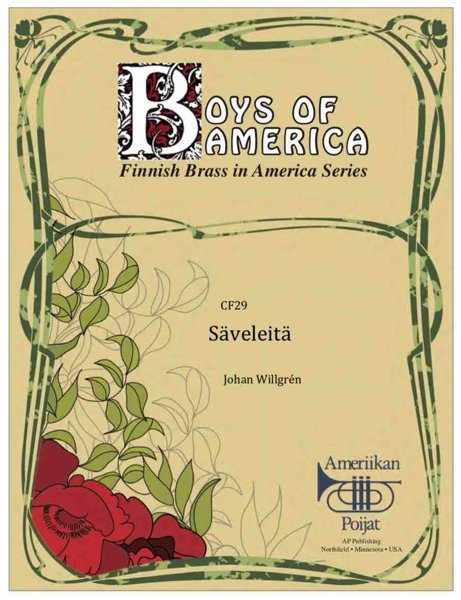
  • Product image of  Säveleitä by Johan Willgrén

    Säveleitä by Johan Willgrén

    15.00 EUR

    Ameriikan poijat Finnish Classics Series Säveleitä- Johan Willgrén. This is one of many fine brass band compositions by Willgrén (1859- 1931), noted Finnish military band conductor. He is best known as a military bandmaster, although his image as a musician was more diverse. Willgrén first studied as a student of Georg Schnéevoigt in Tampere, then under Adolf Leander in Helsinki. From the age of about 20, he founded and conducted orchestras for enthusiasts and was the first conductor of the Helsinki Fire Department's orchestra by 1898. He attended Richard Faltin's School of Music and graduated from the Helsinki Orchestra School. Willgrén served as the leader of the orchestra of the 8th Vyborg Sniper Battalion from 1901-1902. After that, he led the orchestra of the Russian Fortress Battalion for two years in Karelia. The Vyborg Conservatory hired him as a trumpet teacher in 1904. He made a study trip to the Nordic countries and Berlin in 1908 and became acquainted with European orchestras. Returning from the journey in 1909, he founded the Vyborg Brass Band. Willgrén He conducted numerous concerts, founded 16 civilian orchestras in Karelia and served as the leader of many military orchestras, including the Guards Band of Helsinki.. His compositions are about 80 titles and arrangements of about 2,500. Willgrén's arrangements and compositions are often handwritten in bound band part books in various archives around Finland. <pre>All titles have been edited to contain the following parts: </pre> • Standard Finnish septet : E-flat soprano cornet, B-flat cornet I, B-flat cornet II, E-flat alto, B-flat tenor , B-flat baritone, BB-tuba (concert pitch Bass Clef). Our wish is that brass players will try the conical brass instrumentation, but also welcome playing by mixed wind bands. • Additional parts provided: Part 1 in Bb, Part 1 in C, Part 2 in C, Part 3 in C, Part 4 in F, Part 5 in Bb treble, Part 6 in Bb treble, Part 7 in Bb treble (for bass clarinet). This should provide most parts for a standard concert band. Only limited percussion is included, but could be added ad lib. Additional parts in other transpositions can be requested. The Ameriikan poijat Finnish Classics Series presents brass band music of the era around Finnish independence, which has largely not played in more than a century. Manuscripts of his band music was found in national archives, libraries, and community band libraries from around Finland, especially Turku, Pori, Oulainen, Tampere, Mänttä, and Helsinki.. These compositions were coming from a wide range of Finnish cultural organizations from coast to coast and reflect an intense activity during that time. The primary promoters of Finnish community music activity were the Kansanvalistuusseura and the Työväen musiikkiliito, and several other groups. A main source for this repertoire is the military music archives. The scores were often published and then parts were drawn out by the local performing musicians by hand manuscript. The Ameriikan poijat Finnish Classics Series is scored primarily for original Finnish brass septet: E flat Soprano Cornet, two B flat Cornets, an E flat Alto Horn, a B flat Tenor Horn, an Euphonium, and a Tuba. However, these sets also include alternate parts for flute (piccolo), clarinet, French horn, and tenor saxophone. The original seven parts can also be played by other instrumentalists who read those clefs and transpositions (tenor saxophone, bassoon, bass clarinet, etc.) While many of us in Ameriikan poijat have contributed arrangements to this series, it has been primarily of work of Tracey Gibbens, with editing by Russell Pesola and Paul Niemisto. The Finnish brass septet (torviseitsikko in Finnish) has its roots in the late 19th century. The Finns that played in the army bands took their music and instruments home with them and formed brass bands in their home communities. These musicians had been trained in the army to play Russian, German, and authentic Finnish music. Many of them emigrated to America. As the music developed in Finland over the years, the tango, cabaret music, and jazz added their influence to the Finnish septet arrangements. Traveling bands and recordings from other nations influenced the music of the brass septet--and also contributed to its eventual downfall. The septet tried to adapt to these new styles, but soon fell from popularity as jazz and the music of the accordion became more fashionable. By the end of the 1930's, the age of the torviseitsikko was over, and Finland was caught up in the jazz movement. In the 1990's, a revival of the brass septet began to place in Finland due to renewed interest in their own heritage during centennial years. Ameriikan Poijat (Boys of America) is an ensemble of American brass players with an interest in Finnish heritage, playing traditional Finnish brass septet repertoire to American audiences and on international tours. Ameriikan Poijat had the honor to participate in events celebrating Finland's 75th Anniversary of independence in 1992, and has made four tours to Finland. Poijat is pleased to be representing North American Finns, reviving old traditions, and contributing to the appreciation Finnish music.

  • Product image of  Suomen armeijan marssi 1808 sodassa (anon.)

    Suomen armeijan marssi 1808 sodassa (anon.)

    15.00 EUR

    Ameriikan poijat Finnish Classics Series Suomen Armeijan kunniamarssi is a Napoleanic era piece and is anonymous. We found it in several archives and it is a part of the “Kunniamarssit”collection played by Finnish military bands. The Ameriikan poijat Finnish Classics Series presents brass band music of the era around Finnish independence, which has largely not played in more than a century. Manuscripts of his band music was found in national archives, libraries, and community band libraries from around Finland, especially Turku, Pori, Oulainen, Tampere, Mänttä, and Helsinki.. These compositions were coming from a wide range of Finnish cultural organizations from coast to coast and reflect an intense activity during that time. The primary promoters of Finnish community music activity were the Kansanvalistuusseura and the Työväen musiikkiliito, and several other groups. A main source for this repertoire is the military music archives. The scores were often published and then parts were drawn out by the local performing musicians by hand manuscript. All titles have been edited to contain the following parts: • Standard Finnish septet :  E-flat soprano cornet, B-flat cornet I, B-flat cornet II, E-flat alto, B-flat tenor , B-flat baritone, BB-tuba (concert pitch Bass Clef). Our wish is that brass players will try the conical brass instrumentation, but also welcome playing by mixed wind bands. • Additional parts provided:  Part 1 in Bb, Part 1 in C, Part 2  in C, Part 3  in C, Part 4  in F, Part 5 in Bb treble, Part 6 in Bb treble, Part 7 in Bb treble (for bass clarinet). This should provide most parts for a standard concert band. Only limited percussion is included, but could be added ad lib. Additional parts in other transpositions can be requested. The Ameriikan poijat Finnish Classics Series is scored primarily for original Finnish brass septet: E flat Soprano Cornet, two B flat Cornets, an E flat Alto Horn, a B flat Tenor Horn, an Euphonium, and a Tuba. However, these sets also include alternate parts for flute (piccolo), clarinet, French horn, and tenor saxophone. The original seven parts can also be played by other instrumentalists who read those clefs and transpositions (tenor saxophone, bassoon, bass clarinet, etc.) While many of us in Ameriikan poijat have contributed arrangements to this series, it has been primarily of work of Tracey Gibbens, with editing by Russell Pesola and Paul Niemisto. The Finnish brass septet (torviseitsikko in Finnish) has its roots in the late 19th century. The Finns that played in the army bands took their music and instruments home with them and formed brass bands in their home communities. These musicians had been trained in the army to play Russian, German, and authentic Finnish music. Many of them emigrated to America. As the music developed in Finland over the years, the tango, cabaret music, and jazz added their influence to the Finnish septet arrangements. Traveling bands and recordings from other nations influenced the music of the brass septet--and also contributed to its eventual downfall. The septet tried to adapt to these new styles, but soon fell from popularity as jazz and the music of the accordion became more fashionable. By the end of the 1930's, the age of the torviseitsikko was over, and Finland was caught up in the jazz movement. In the 1990's, a revival of the brass septet began to place in Finland due to renewed interest in their own heritage during centennial years. Ameriikan Poijat (Boys of America) is an ensemble of American brass players with an interest in Finnish heritage, playing traditional Finnish brass septet repertoire to American audiences and on international tours. Ameriikan Poijat had the honor to participate in events celebrating Finland's 75th Anniversary of independence in 1992, and has made four tours to Finland. Poijat is pleased to be representing North American Finns, reviving old traditions, and contributing to the appreciation Finnish music.

  • Product image of  Mustalainen valssi (“Gypsy Waltz”)

    Mustalainen valssi (“Gypsy Waltz”)

    15.00 EUR

    Mustalainen valssi (“Gypsy Waltz”) is based on the very familiar Sarasate violin tune (Zeigeunerwise),which is in a duple tempo. American Finns such as Viola Torpeinen and Willy Larson performed it as a waltz, and so this version is immigrant music, mostly unknown in Finland. All titles have been edited to contain the following parts: • Standard Finnish septet :  E-flat soprano cornet, B-flat cornet I, B-flat cornet II, E-flat alto, B-flat tenor , B-flat baritone, BB-tuba (concert pitch Bass Clef). Our wish is that brass players will try the conical brass instrumentation, but also welcome playing by mixed wind bands. • Additional parts provided:  Part 1 in Bb, Part 1 in C, Part 2  in C, Part 3  in C, Part 4  in F, Part 5 in Bb treble, Part 6 in Bb treble, Part 7 in Bb treble (for bass clarinet). This should provide most parts for a standard concert band. Only limited percussion is included, but could be added ad lib. Additional parts in other transpositions can be requested. The Finnish Brass in America Series presents brass band music of immigrants and has not played in more than a century. This band sheet music was found in community band libraries and in archives in Hancock, Michigan- Virginia, Minnesota- Minneapolis, Minnesota – Conneaut, Ohio, and Fitchburg, Massachusetts. These compositions were coming from a much wider range of Finnish immigrant communities from coast to coast and reflect an intense activity during that time. The primary promoter of Finnish community music activity in the U.S. in the early 1900s was the Sibelius Club of Monessen, Pennsylvania. In cooperation with the HN White Music Company of nearby Cleveland, the Sibelius Club published many band pieces, some of which are included in this series. Several compositions are also from unpublished manuscripts. The Finnish Brass in America Series is scored primarily for original Finnish brass septet: E flat Soprano Cornet, two B flat Cornets, an E flat Alto Horn, a B flat Tenor Horn, an Euphonium, and a Tuba. However, these sets also include alternate parts for flute (piccolo), clarinet, French horn, and tenor saxophone. The original seven parts can also be played by other instrumentalists who read those clefs and transpositions (tenor saxophone, bassoon, bass clarinet, etc.) While many of us in Ameriikan poijat have contributed arrangements to this series, it has been primarily of work of Tracey Gibbens, with editing by Russell Pesola and Paul Niemisto. The Finnish brass septet (torviseitsikko in Finnish) has its roots in the late 19th century. The Finns that played in the army bands took their music and instruments home with them and formed brass bands in their home communities. These musicians had been trained in the army to play Russian, German, and authentic Finnish music. Many of them emigrated to America. As the music developed in Finland over the years, the tango, cabaret music, and jazz added their influence to the Finnish septet arrangements. Traveling bands and recordings from other nations influenced the music of the brass septet--and also contributed to its eventual downfall. The septet tried to adapt to these new styles, but soon fell from popularity as jazz and the music of the accordion became more fashionable. By the end of the 1930's, the age of the torviseitsikko was over, and Finland was caught up in the jazz movement. In the 1990's, a revival of the brass septet began to place in Finland due to renewed interest in their own heritage during centennial years. Ameriikan Poijat (Boys of America) is an ensemble of American brass players with an interest in Finnish heritage, playing traditional Finnish brass septet repertoire to American audiences and on international tours. Ameriikan Poijat had the honor to participate in events celebrating Finland's 75th Anniversary of independence in 1992, and has made four tours to Finland. Poijat is pleased to be representing North American Finns, reviving old traditions, and contributing to the appreciation Finnish music.

  • Product image of  Punainen ruusu - The Rose is Red by A.Halonen

    Punainen ruusu - The Rose is Red by A.Halonen

    15.00 EUR

    Punainen ruusu (Red Rose) is a waltz thought to be written by A. Halonen for the Duluth Finnish Workers’ Band. Menne Wanhala, the band’s leader is the probable arranger. The material was found at the Accordion Museum in Superior, Wisconsin. Nothing has been found about Halonen’s life story. The band music collection at the Accordion Museum is all from Menne Wanhala. The Finnish Brass in America Series presents brass band music of immigrants and has not played in more than a century. This band sheet music was found in community band libraries and in archives in Hancock, Michigan- Virginia, Minnesota- Minneapolis, Minnesota – Conneaut, Ohio, and Fitchburg, Massachusetts. These compositions were coming from a much wider range of Finnish immigrant communities from coast to coast and reflect an intense activity during that time. The primary promoter of Finnish community music activity in the U.S. in the early 1900s was the Sibelius Club of Monessen, Pennsylvania. In cooperation with the HN White Music Company of nearby Cleveland, the Sibelius Club published many band pieces, some of which are included in this series. Several compositions are also from unpublished manuscripts. All titles have been edited to contain the following parts: • Standard Finnish septet :  E-flat soprano cornet, B-flat cornet I, B-flat cornet II, E-flat alto, B-flat tenor , B-flat baritone, BB-tuba (concert pitch Bass Clef). Our wish is that brass players will try the conical brass instrumentation, but also welcome playing by mixed wind bands. • Additional parts provided:  Part 1 in Bb, Part 1 in C, Part 2  in C, Part 3  in C, Part 4  in F, Part 5 in Bb treble, Part 6 in Bb treble, Part 7 in Bb treble (for bass clarinet). This should provide most parts for a standard concert band. Only limited percussion is included, but could be added ad lib. Additional parts in other transpositions can be requested. The Finnish Brass in America Series is scored primarily for original Finnish brass septet: E flat Soprano Cornet, two B flat Cornets, an E flat Alto Horn, a B flat Tenor Horn, an Euphonium, and a Tuba. However, these sets also include alternate parts for flute (piccolo), clarinet, French horn, and tenor saxophone. The original seven parts can also be played by other instrumentalists who read those clefs and transpositions (tenor saxophone, bassoon, bass clarinet, etc.) While many of us in Ameriikan poijat have contributed arrangements to this series, it has been primarily of work of Tracey Gibbens, with editing by Russell Pesola and Paul Niemisto. The Finnish brass septet (torviseitsikko in Finnish) has its roots in the late 19th century. The Finns that played in the army bands took their music and instruments home with them and formed brass bands in their home communities. These musicians had been trained in the army to play Russian, German, and authentic Finnish music. Many of them emigrated to America. As the music developed in Finland over the years, the tango, cabaret music, and jazz added their influence to the Finnish septet arrangements. Traveling bands and recordings from other nations influenced the music of the brass septet--and also contributed to its eventual downfall. The septet tried to adapt to these new styles, but soon fell from popularity as jazz and the music of the accordion became more fashionable. By the end of the 1930's, the age of the torviseitsikko was over, and Finland was caught up in the jazz movement. In the 1990's, a revival of the brass septet began to place in Finland due to renewed interest in their own heritage during centennial years. Ameriikan Poijat (Boys of America) is an ensemble of American brass players with an interest in Finnish heritage, playing traditional Finnish brass septet repertoire to American audiences and on international tours. Ameriikan Poijat had the honor to participate in events celebrating Finland's 75th Anniversary of independence in 1992, and has made four tours to Finland.

  • Product image of  Helsinki Bicycle Club Parade March by Harald Hedman

    Helsinki Bicycle Club Parade March by Harald Hedman

    15.00 EUR

    Helsingin polkupyöräklubin marssi/The Helsingfors Welociped Klubbs Marsch (Helsinki Bicycle Club March -1897) by Harald Hedman, was performed during bicycle club events in Helsinki summers, when bicycling was very popular around 1900 and later. It was found in the archives of the Helsinki Brass Band (Helsingin torvisoittokunta) led by Alexei Apostol. Harald Hedman, a notable Finnish musician, composer, and military bandmaster, was born in Kajaani in 1874 and attended school in Kuopio and died young. In addition to his career as military bandmaster in Oulu, he also played violin and taught at the Church Music School in Viipuri. In Helsinki he was a military music student of Adolf Leander and played percussion in Robert Kajanus’ Helsinki orchestra. He wrote several pieces for torvisoittokunta, the most notable being his Sven Dufva Overture, known by most Finnish wind players. A fine concert piece of his, the Polkupyöräiliä Fantasia (Bicycle Rider's Descriptive Fantasia), deserves to be better known. He also wrote prolifically for piano, choir, and other media. He died in 1902 while on summer vacation in Kuopio. All titles have been edited to contain the following parts: • Standard Finnish septet :  E-flat soprano cornet, B-flat cornet I, B-flat cornet II, E-flat alto, B-flat tenor , B-flat baritone, BB-tuba (concert pitch Bass Clef). Our wish is that brass players will try the conical brass instrumentation, but also welcome playing by mixed wind bands. • Additional parts provided:  Part 1 in Bb, Part 1 in C, Part 2  in C, Part 3  in C, Part 4  in F, Part 5 in Bb treble, Part 6 in Bb treble, Part 7 in Bb treble (for bass clarinet). This should provide most parts for a standard concert band. Only limited percussion is included, but could be added ad lib. Additional parts in other transpositions can be requested. The Finnish Brass in America Series presents brass band music of immigrants and has not played in more than a century. This band sheet music was found in community band libraries and in archives in Hancock, Michigan- Virginia, Minnesota- Minneapolis, Minnesota – Conneaut, Ohio, and Fitchburg, Massachusetts. These compositions were coming from a much wider range of Finnish immigrant communities from coast to coast and reflect an intense activity during that time. The primary promoter of Finnish community music activity in the U.S. in the early 1900s was the Sibelius Club of Monessen, Pennsylvania. In cooperation with the HN White Music Company of nearby Cleveland, the Sibelius Club published many band pieces, some of which are included in this series. Several compositions are also from unpublished manuscripts. The Finnish Brass in America Series is scored primarily for original Finnish brass septet: E flat Soprano Cornet, two B flat Cornets, an E flat Alto Horn, a B flat Tenor Horn, and Euphonium, and a Tuba. However, these sets also include alternate parts for flute (piccolo), clarinet, French horn, and tenor saxophone. The original seven parts can also be played by other instrumentalists who read those clefs and transpositions (tenor saxophone, bassoon, bass clarinet, etc.) While many of us in Ameriikan poijat have contributed arrangements to this series, it has been primarily of work of Tracey Gibbens, with editing by Russell Pesola and Paul Niemisto. The Finnish brass septet (torviseitsikko in Finnish) has its roots in the late 19th century. The Finns that played in the army bands took their music and instruments home with them and formed brass bands in their home communities. These musicians had been trained in the army to play Russian, German, and authentic Finnish music. Many of them emigrated to America. As the music developed in Finland over the years, the tango, cabaret music, and jazz added their influence to the Finnish septet arrangements. Traveling bands and recordings from other nations influenced the music of the brass septet--and also contributed to its eventual downfall. The septet tried to adapt to these new styles, but soon fell from popularity as jazz and the music of the accordion became more fashionable. By the end of the 1930's, the age of the torviseitsikko was over, and Finland was caught up in the jazz movement. In the 1990's, a revival of the brass septet began to place in Finland due to renewed interest in their own heritage during centennial years. Ameriikan Poijat (Boys of America) is an ensemble of American brass players with an interest in Finnish heritage, playing traditional Finnish brass septet repertoire to American audiences and on international tours. Ameriikan Poijat had the honor to participate in events celebrating Finland's 75th Anniversary of independence in 1992 and has made four tours to Finland. Poijat is pleased to be representing North American Finns, reviving old traditions, and contributing to the appreciation Finnish music.

  • Product image of  Polkupyöräilijä Fantasia by Harald Hedman

    Polkupyöräilijä Fantasia by Harald Hedman

    15.00 EUR

    The Polkupyöräiliä Fantasia (Bicycle Rider's Descriptive Fantasia) by Harald Hedman, was performed during bicycle club events in Helsinki summers, when the club was very popular around 1900 and later. It was found in the archives of the Helsinki Brass Band (Helsingin torvisoittokunta) led by Alexei Apostol. Harald Hedmn, a notable Finnish musician, composer, and military bandmaster, was born in Kajaani in 1874 and attended school in Kuopio and died young. In addition to his career as military bandmaster in Oulu, he also played violin and taught at the Church Music School in Viipuri. In Helsinki he was a military music student of Adolf Leander and played percussion in Robert Kajanus’ Helsinki orchestra. He wrote several pieces for torvisoittokunta, the most notable being his Sven Dufva Overture, known by most Finnish wind players. A great march of his is the Helsingfors velociped klubbs marsch (1897) which deserves to be better known. He also wrote prolifically for piano, choir, and other media. He died in 1902 while on summer vacation in Kuopio. All titles have been edited to contain the following parts: • Standard Finnish septet :  E-flat soprano cornet, B-flat cornet I, B-flat cornet II, E-flat alto, B-flat tenor , B-flat baritone, BB-tuba (concert pitch Bass Clef). Our wish is that brass players will try the conical brass instrumentation, but also welcome playing by mixed wind bands. • Additional parts provided:  Part 1 in Bb, Part 1 in C, Part 2  in C, Part 3  in C, Part 4  in F, Part 5 in Bb treble, Part 6 in Bb treble, Part 7 in Bb treble (for bass clarinet). This should provide most parts for a standard concert band. Only limited percussion is included, but could be added ad lib. Additional parts in other transpositions can be requested. The Finnish Brass in America Series presents brass band music of immigrants and has not played in more than a century. This band sheet music was found in community band libraries and in archives in Hancock, Michigan- Virginia, Minnesota- Minneapolis, Minnesota – Conneaut, Ohio, and Fitchburg, Massachusetts. These compositions were coming from a much wider range of Finnish immigrant communities from coast to coast and reflect an intense activity during that time. The primary promoter of Finnish community music activity in the U.S. in the early 1900s was the Sibelius Club of Monessen, Pennsylvania. In cooperation with the HN White Music Company of nearby Cleveland, the Sibelius Club published many band pieces, some of which are included in this series. Several compositions are also from unpublished manuscripts. The Finnish Brass in America Series is scored primarily for original Finnish brass septet: E flat Soprano Cornet, two B flat Cornets, an E flat Alto Horn, a B flat Tenor Horn, and Euphonium, and a Tuba. However, these sets also include alternate parts for flute (piccolo), clarinet, French horn, and tenor saxophone. The original seven parts can also be played by other instrumentalists who read those clefs and transpositions (tenor saxophone, bassoon, bass clarinet, etc.) While many of us in Ameriikan poijat have contributed arrangements to this series, it has been primarily of work of Tracey Gibbens, with editing by Russell Pesola and Paul Niemisto. The Finnish brass septet (torviseitsikko in Finnish) has its roots in the late 19th century. The Finns that played in the army bands took their music and instruments home with them and formed brass bands in their home communities. These musicians had been trained in the army to play Russian, German, and authentic Finnish music. Many of them emigrated to America. As the music developed in Finland over the years, the tango, cabaret music, and jazz added their influence to the Finnish septet arrangements. Traveling bands and recordings from other nations influenced the music of the brass septet--and also contributed to its eventual downfall. The septet tried to adapt to these new styles, but soon fell from popularity as jazz and the music of the accordion became more fashionable. By the end of the 1930's, the age of the torviseitsikko was over, and Finland was caught up in the jazz movement. In the 1990's, a revival of the brass septet began to place in Finland due to renewed interest in their own heritage during centennial years. Ameriikan Poijat (Boys of America) is an ensemble of American brass players with an interest in Finnish heritage, playing traditional Finnish brass septet repertoire to American audiences and on international tours. Ameriikan Poijat had the honor to participate in events celebrating Finland's 75th Anniversary of independence in 1992 and has made four tours to Finland. Poijat is pleased to be representing North American Finns, reviving old traditions, and contributing to the appreciation Finnish music.

  • Product image of  Sven Dufva Overture by Harald Hedman

    Sven Dufva Overture by Harald Hedman

    15.00 EUR

    This overture is based on the saga-poem “Sven Dufva” by Finnish poet Johan Ludwig Runeberg. It is the story of a boyhood hero in the Russo-Finnish War of 1807. The tale is somewhat revealed by this early quote from the poem: “With best will, did whatever was asked but always did it wrong”- Sven Dufva later became a soldier- and a hero. This music is well known in Finland, arranged for many instrumental combinations but was originally for brass. This version is based on a band arrangement by Theo Tobani for the Sibelius Clun of Monessen, Pennsylvania. Harald Hedman, a notable Finnish musician, composer, and military bandmaster, was born in Kajaani in 1874 and attended school in Kuopio and died young. In addition to his career as military bandmaster in Oulu, he also played violin and taught at the Church Music School in Viipuri. In Helsinki he was a military music student of Adolf Leander and played percussion in Robert Kajanus’ Helsinki orchestra. He wrote several pieces for torvisoittokunta, the most notable being his Sven Dufva Overture, known by most Finnish wind players. A great march of his is the Helsingfors velociped klubbs marsch (1897) which deserves to be better known. He also wrote prolifically for piano, choir, and other media. He died in 1902 while on summer vacation in Kuopio. All titles have been edited to contain the following parts: • Standard Finnish septet :  E-flat soprano cornet, B-flat cornet I, B-flat cornet II, E-flat alto, B-flat tenor , B-flat baritone, BB-tuba (concert pitch Bass Clef). Our wish is that brass players will try the conical brass instrumentation, but also welcome playing by mixed wind bands. • Additional parts provided:  Part 1 in Bb, Part 1 in C, Part 2  in C, Part 3  in C, Part 4  in F, Part 5 in Bb treble, Part 6 in Bb treble, Part 7 in Bb treble (for bass clarinet). This should provide most parts for a standard concert band. Only limited percussion is included, but could be added ad lib. Additional parts in other transpositions can be requested. The Finnish Brass in America Series presents brass band music of immigrants and has not played in more than a century. This band sheet music was found in community band libraries and in archives in Hancock, Michigan- Virginia, Minnesota- Minneapolis, Minnesota – Conneaut, Ohio, and Fitchburg, Massachusetts. These compositions were coming from a much wider range of Finnish immigrant communities from coast to coast and reflect an intense activity during that time. The primary promoter of Finnish community music activity in the U.S. in the early 1900s was the Sibelius Club of Monessen, Pennsylvania. In cooperation with the HN White Music Company of nearby Cleveland, the Sibelius Club published many band pieces, some of which are included in this series. Several compositions are also from unpublished manuscripts. The Finnish Brass in America Series is scored primarily for original Finnish brass septet: E flat Soprano Cornet, two B flat Cornets, an E flat Alto Horn, a B flat Tenor Horn, and Euphonium, and a Tuba. However, these sets also include alternate parts for flute (piccolo), clarinet, French horn, and tenor saxophone. The original seven parts can also be played by other instrumentalists who read those clefs and transpositions (tenor saxophone, bassoon, bass clarinet, etc.) While many of us in Ameriikan poijat have contributed arrangements to this series, it has been primarily of work of Tracey Gibbens, with editing by Russell Pesola and Paul Niemisto. The Finnish brass septet (torviseitsikko in Finnish) has its roots in the late 19th century. The Finns that played in the army bands took their music and instruments home with them and formed brass bands in their home communities. These musicians had been trained in the army to play Russian, German, and authentic Finnish music. Many of them emigrated to America. As the music developed in Finland over the years, the tango, cabaret music, and jazz added their influence to the Finnish septet arrangements. Traveling bands and recordings from other nations influenced the music of the brass septet--and also contributed to its eventual downfall. The septet tried to adapt to these new styles, but soon fell from popularity as jazz and the music of the accordion became more fashionable. By the end of the 1930's, the age of the torviseitsikko was over, and Finland was caught up in the jazz movement. In the 1990's, a revival of the brass septet began to place in Finland due to renewed interest in their own heritage during centennial years. Ameriikan Poijat (Boys of America) is an ensemble of American brass players with an interest in Finnish heritage, playing traditional Finnish brass septet repertoire to American audiences and on international tours. Ameriikan Poijat had the honor to participate in events celebrating Finland's 75th Anniversary of independence in 1992 and has made four tours to Finland. Poijat is pleased to be representing North American Finns, reviving old traditions, and contributing to the appreciation Finnish music.

  • Product image of  Maailman Matti - Jenkka/Schottische

    Maailman Matti - Jenkka/Schottische

    15.00 EUR

    Maailman Matti- Jenkka/Schottische is one of the most popular dance tunes among Finnish Americans and was recorded by several popular singers and bands. It’s source in unknown. It has a romantic theme to the lyrics – young love: “My sweetheart’s (Heilani) house it is on the lake and is painted red. I go there night or day, and the doors are open. Heilani’ s room is covered with silk. I go night or day, and the coffee is brewed. American fleece leggings, and use the backs to turn, turn, turn. The girl said to the boy, that we would hug now, now, now. I am a Matti, Man of the World. I’m that singer Matti. I have gold in Kuopio and in Kajaani too. Can't be a dad, can't be a mom, do not mourn the dried flower. For this young boy has to go, in the mind of the world.” The tune is attributed to “F. Hill”- and based on an arrangement by Oskar Suojanen for the Berkeley Finnish Socialist Band. All titles have been edited to contain the following parts: Standard Finnish septet :  E-flat soprano cornet, B-flat cornet I, B-flat cornet II, E-flat alto, B-flat tenor , B-flat baritone, BB-tuba (concert pitch Bass Clef). Our wish is that brass players will try the conical brass instrumentation, but also welcome playing by mixed wind bands. • Additional parts provided:  Part 1 in Bb, Part 1 in C, Part 2  in C, Part 3  in C, Part 4  in F, Part 5 in Bb treble, Part 6 in Bb treble, Part 7 in Bb treble (for bass clarinet). This should provide most parts for a standard concert band. Only limited percussion is included, but could be added ad lib. Additional parts in other transpositions can be requested. The Finnish Brass in America Series presents brass band music of immigrants and has not played in more than a century. This band sheet music was found in community band libraries and in archives in Hancock, Michigan- Virginia, Minnesota- Minneapolis, Minnesota – Conneaut, Ohio, and Fitchburg, Massachusetts. These compositions were coming from a much wider range of Finnish immigrant communities from coast to coast and reflect an intense activity during that time. The primary promoter of Finnish community music activity in the U.S. in the early 1900s was the Sibelius Club of Monessen, Pennsylvania. In cooperation with the HN White Music Company of nearby Cleveland, the Sibelius Club published many band pieces, some of which are included in this series. Several compositions are also from unpublished manuscripts. The Finnish Brass in America Series is scored primarily for original Finnish brass septet: E flat Soprano Cornet, two B flat Cornets, an E flat Alto Horn, a B flat Tenor Horn, and Euphonium, and a Tuba. However, these sets also include alternate parts for flute (piccolo), clarinet, French horn, and tenor saxophone. The original seven parts can also be played by other instrumentalists who read those clefs and transpositions (tenor saxophone, bassoon, bass clarinet, etc.) While many of us in Ameriikan poijat have contributed arrangements to this series, it has been primarily of work of Tracey Gibbens, with editing by Russell Pesola and Paul Niemisto. The Finnish brass septet (torviseitsikko in Finnish) has its roots in the late 19th century. The Finns that played in the army bands took their music and instruments home with them and formed brass bands in their home communities. These musicians had been trained in the army to play Russian, German, and authentic Finnish music. Many of them emigrated to America. As the music developed in Finland over the years, the tango, cabaret music, and jazz added their influence to the Finnish septet arrangements. Traveling bands and recordings from other nations influenced the music of the brass septet--and also contributed to its eventual downfall. The septet tried to adapt to these new styles, but soon fell from popularity as jazz and the music of the accordion became more fashionable. By the end of the 1930's, the age of the torviseitsikko was over, and Finland was caught up in the jazz movement. In the 1990's, a revival of the brass septet began to place in Finland due to renewed interest in their own heritage during centennial years. Ameriikan Poijat (Boys of America) is an ensemble of American brass players with an interest in Finnish heritage, playing traditional Finnish brass septet repertoire to American audiences and on international tours. Ameriikan Poijat had the honor to participate in events celebrating Finland's 75th Anniversary of independence in 1992 and has made four tours to Finland. Poijat is pleased to be representi

  • Product image of  Kesäyö by Armas Järnefelt

    Kesäyö by Armas Järnefelt

    15.00 EUR

    Kesäyö is one of many short descriptive instrumental works by Edvard Armas Järnefelt (14 August 1869 – 23 June 1958). He was a Finnish conductor and composer, who achieved some minor success with such orchestral music Berceuse and Praeludium. He spent much of his conducting career at the Royal Swedish Opera in Stockholm, Sweden. Many of these works have been transcribed for Seitsikko. Järnefelt was born in Vyborg, is the son of General August Aleksander Järnefelt and Elisabeth Järnefelt (née Clodt von Jürgensburg). Järnefelt studied with Ferruccio Busoni in Helsinki and with Jules Massenet in Paris. Both Järnefelt and Busoni enjoyed a close relationship with Jean Sibelius, who was married to Järnefelt's sister Aino. Between 1932-36 Järnefelt was the artistic director and conductor of the Finnish National Opera. He presented, among others, Siegfried and Götterdämmerung from Wagner's Ring cycle, and Parsifal. He was principal conductor of the Helsinki Philharmonic Orchestra 1942–1943, and also returned to the Royal Swedish Opera as chief conductor from 1938 to 1946. He died in Stockholm. All titles have been edited to contain the following parts: Standard Finnish septet :  E-flat soprano cornet, B-flat cornet I, B-flat cornet II, E-flat alto, B-flat tenor , B-flat baritone, BB-tuba (concert pitch Bass Clef). Our wish is that brass players will try the conical brass instrumentation, but also welcome playing by mixed wind bands. • Additional parts provided:  Part 1 in Bb, Part 1 in C, Part 2  in C, Part 3  in C, Part 4  in F, Part 5 in Bb treble, Part 6 in Bb treble, Part 7 in Bb treble (for bass clarinet). This should provide most parts for a standard concert band. Only limited percussion is included, but could be added ad lib. Additional parts in other transpositions can be requested. The Finnish Brass in America Series presents brass band music of immigrants and has not played in more than a century. This band sheet music was found in community band libraries and in archives in Hancock, Michigan- Virginia, Minnesota- Minneapolis, Minnesota – Conneaut, Ohio, and Fitchburg, Massachusetts. These compositions were coming from a much wider range of Finnish immigrant communities from coast to coast and reflect an intense activity during that time. The primary promoter of Finnish community music activity in the U.S. in the early 1900s was the Sibelius Club of Monessen, Pennsylvania. In cooperation with the HN White Music Company of nearby Cleveland, the Sibelius Club published many band pieces, some of which are included in this series. Several compositions are also from unpublished manuscripts. The Finnish Brass in America Series is scored primarily for original Finnish brass septet: E flat Soprano Cornet, two B flat Cornets, an E flat Alto Horn, a B flat Tenor Horn, and Euphonium, and a Tuba. However, these sets also include alternate parts for flute (piccolo), clarinet, French horn, and tenor saxophone. The original seven parts can also be played by other instrumentalists who read those clefs and transpositions (tenor saxophone, bassoon, bass clarinet, etc.) While many of us in Ameriikan poijat have contributed arrangements to this series, it has been primarily of work of Tracey Gibbens, with editing by Russell Pesola and Paul Niemisto. The Finnish brass septet (torviseitsikko in Finnish) has its roots in the late 19th century. The Finns that played in the army bands took their music and instruments home with them and formed brass bands in their home communities. These musicians had been trained in the army to play Russian, German, and authentic Finnish music. Many of them emigrated to America. As the music developed in Finland over the years, the tango, cabaret music, and jazz added their influence to the Finnish septet arrangements. Traveling bands and recordings from other nations influenced the music of the brass septet--and also contributed to its eventual downfall. The septet tried to adapt to these new styles, but soon fell from popularity as jazz and the music of the accordion became more fashionable. By the end of the 1930's, the age of the torviseitsikko was over, and Finland was caught up in the jazz movement. In the 1990's, a revival of the brass septet began to place in Finland due to renewed interest in their own heritage during centennial years. Ameriikan Poijat (Boys of America) is an ensemble of American brass players with an interest in Finnish heritage, playing traditional Finnish brass septet repertoire to American audiences and on international tours. Ameriikan Poijat had the honor to participate in events celebrating Finland's 75th Anniversary of independence in 1992 and has made four tours to Finland. Poijat is pleased to be representing North American Finns, reviving old traditions, and contributing to the appreciation Finnish music.
  • Product image of  Virran rannalla (By the Stream) by Armas Järnefelt

    Virran rannalla (By the Stream) by Armas Järnefelt

    15.00 EUR

    Virran rannalla (By the Stream) is one of many short descriptive instrumental works with folk elements by Edvard Armas Järnefelt (14 August 1869 – 23 June 1958). He was a Finnish conductor and composer, who achieved some minor success with such orchestral music Berceuse and Praeludium. He spent much of his conducting career at the Royal Swedish Opera in Stockholm, Sweden. Many of these works have been transcribed for Seitsikko. Järnefelt was born in Vyborg, in the son of General August Aleksander Järnefelt and Elisabeth Järnefelt (née Clodt von Jürgensburg). Järnefelt studied with Ferruccio Busoni in Helsinki and with Jules Massenet in Paris. Both Järnefelt and Busoni enjoyed a close relationship with Jean Sibelius, who was married to Järnefelt's sister Aino. Between 1932-36 Järnefelt was the artistic director and conductor of the Finnish National Opera. He presented, among others, Siegfried and Götterdämmerung from Wagner's Ring cycle, and Parsifal. He was principal conductor of the Helsinki Philharmonic Orchestra 1942–1943, and also returned to the Royal Swedish Opera as chief conductor from 1938 to 1946. He died in Stockholm. All titles have been edited to contain the following parts: Standard Finnish septet :  E-flat soprano cornet, B-flat cornet I, B-flat cornet II, E-flat alto, B-flat tenor , B-flat baritone, BB-tuba (concert pitch Bass Clef). Our wish is that brass players will try the conical brass instrumentation, but also welcome playing by mixed wind bands. Additional parts provided:  Part 1 in Bb, Part 1 in C, Part 2  in C, Part 3  in C, Part 4  in F, Part 5 in Bb treble, Part 6 in Bb treble, Part 7 in Bb treble (for bass clarinet). This should provide most parts for a standard concert band. Only limited percussion is included, but could be added ad lib. Additional parts in other transpositions can be requested. The Finnish Brass in America Series presents brass band music of immigrants and has not played in more than a century. This band sheet music was found in community band libraries and in archives in Hancock, Michigan- Virginia, Minnesota- Minneapolis, Minnesota – Conneaut, Ohio, and Fitchburg, Massachusetts. These compositions were coming from a much wider range of Finnish immigrant communities from coast to coast and reflect an intense activity during that time. The primary promoter of Finnish community music activity in the U.S. in the early 1900s was the Sibelius Club of Monessen, Pennsylvania. In cooperation with the HN White Music Company of nearby Cleveland, the Sibelius Club published many band pieces, some of which are included in this series. Several compositions are also from unpublished manuscripts. The Finnish Brass in America Series is scored primarily for original Finnish brass septet: E flat Soprano Cornet, two B flat Cornets, an E flat Alto Horn, a B flat Tenor Horn, and Euphonium, and a Tuba. However, these sets also include alternate parts for flute (piccolo), clarinet, French horn, and tenor saxophone. The original seven parts can also be played by other instrumentalists who read those clefs and transpositions (tenor saxophone, bassoon, bass clarinet, etc.) While many of us in Ameriikan poijat have contributed arrangements to this series, it has been primarily of work of Tracey Gibbens, with editing by Russell Pesola and Paul Niemisto. The Finnish brass septet (torviseitsikko in Finnish) has its roots in the late 19th century. The Finns that played in the army bands took their music and instruments home with them and formed brass bands in their home communities. These musicians had been trained in the army to play Russian, German, and authentic Finnish music. Many of them emigrated to America. As the music developed in Finland over the years, the tango, cabaret music, and jazz added their influence to the Finnish septet arrangements. Traveling bands and recordings from other nations influenced the music of the brass septet--and also contributed to its eventual downfall. The septet tried to adapt to these new styles, but soon fell from popularity as jazz and the music of the accordion became more fashionable. By the end of the 1930's, the age of the torviseitsikko was over, and Finland was caught up in the jazz movement. In the 1990's, a revival of the brass septet began to place in Finland due to renewed interest in their own heritage during centennial years. Ameriikan Poijat (Boys of America) is an ensemble of American brass players with an interest in Finnish heritage, playing traditional Finnish brass septet repertoire to American audiences and on international tours. Ameriikan Poijat had the honor to participate in events celebrating Finland's 75th Anniversary of independence in 1992 and has made four tours to Finland. Poijat is pleased to be representing North American Finns, reviving old traditions, and contributing to the appreciation Finnish music.
  • Product image of  Kotimaani ompi Suomi - Folk Song Arr. T. Gibbens

    Kotimaani ompi Suomi - Folk Song Arr. T. Gibbens

    15.00 EUR

    Kotimaani ompi Suomi (dedicated to Paul Niemisto's Grandson, Fynn) (“Finland is my Home”) has become a popular patriotic anthem in the “old country” and is also well known among Finnish Americans. The words and music were composed by American Finn Joseph Riippa in 1890s. The original materials are lost, so it is usually noted as a "traditional folk song". This is Tracey Gibbens’ original arrangement, which Ameriikan poijat has used as a concert overture, including narration. All titles have been edited to contain the following parts: Standard Finnish septet :  E-flat soprano cornet, B-flat cornet I, B-flat cornet II, E-flat alto, B-flat tenor , B-flat baritone, BB-tuba (concert pitch Bass Clef). Our wish is that brass players will try the conical brass instrumentation, but also welcome playing by mixed wind bands. Additional parts provided:  Part 1 in Bb, Part 1 in C, Part 2  in C, Part 3  in C, Part 4  in F, Part 5 in Bb treble, Part 6 in Bb treble, Part 7 in Bb treble (for bass clarinet). This should provide most parts for a standard concert band. Only limited percussion is included, but could be added ad lib. Additional parts in other transpositions can be requested. The Finnish Brass in America Series presents brass band music of immigrants and has not played in more than a century. This band sheet music was found in community band libraries and in archives in Hancock, Michigan- Virginia, Minnesota- Minneapolis, Minnesota – Conneaut, Ohio, and Fitchburg, Massachusetts. These compositions were coming from a much wider range of Finnish immigrant communities from coast to coast and reflect an intense activity during that time. The primary promoter of Finnish community music activity in the U.S. in the early 1900s was the Sibelius Club of Monessen, Pennsylvania. In cooperation with the HN White Music Company of nearby Cleveland, the Sibelius Club published many band pieces, some of which are included in this series. Several compositions are also from unpublished manuscripts. The Finnish Brass in America Series is scored primarily for original Finnish brass septet: E flat Soprano Cornet, two B flat Cornets, an E flat Alto Horn, a B flat Tenor Horn, and Euphonium, and a Tuba. However, these sets also include alternate parts for flute (piccolo), clarinet, French horn, and tenor saxophone. The original seven parts can also be played by other instrumentalists who read those clefs and transpositions (tenor saxophone, bassoon, bass clarinet, etc.) While many of us in Ameriikan poijat have contributed arrangements to this series, it has been primarily of work of Tracey Gibbens, with editing by Russell Pesola and Paul Niemisto. The Finnish brass septet (torviseitsikko in Finnish) has its roots in the late 19th century. The Finns that played in the army bands took their music and instruments home with them and formed brass bands in their home communities. These musicians had been trained in the army to play Russian, German, and authentic Finnish music. Many of them emigrated to America. As the music developed in Finland over the years, the tango, cabaret music, and jazz added their influence to the Finnish septet arrangements. Traveling bands and recordings from other nations influenced the music of the brass septet--and also contributed to its eventual downfall. The septet tried to adapt to these new styles, but soon fell from popularity as jazz and the music of the accordion became more fashionable. By the end of the 1930's, the age of the torviseitsikko was over, and Finland was caught up in the jazz movement. In the 1990's, a revival of the brass septet began to place in Finland due to renewed interest in their own heritage during centennial years. Ameriikan Poijat (Boys of America) is an ensemble of American brass players with an interest in Finnish heritage, playing traditional Finnish brass septet repertoire to American audiences and on international tours. Ameriikan Poijat had the honor to participate in events celebrating Finland's 75th Anniversary of independence in 1992 and has made four tours to Finland. Poijat is pleased to be representing North American Finns, reviving old traditions, and contributing to the appreciation Finnish music.

  • Product image of  Yohly Heaver! Up She Goes!

    Yohly Heaver! Up She Goes!

    15.00 EUR

    Johli hiiveri, hopsikko! marssi (Yohli Heaver Up She Goes March) – by Charles Kleemola (1880- 1915). Kleemola was born in Finland and came to Monessen, Pennsylvania as a boy where he apparently began to play cornet. His family moved to Ironwood, Michigan, where he eventually played with the local National Guard Band during the Spanish American War. He went on to Ely Minnesota where he led the very successful “Sampo” Band for several years. He also appears in photographs as a cornet player in many Finnish bands around the U.S. Yohli Heaver, probably written for a summer festival, celebrates the big steam powered log booms that loaded timber in an out of Ely’s Burnside Lake. The march is self-published and was found by us in the family’s collection. Kleemola wrote a school song for the earliest Ely High School Band, and probably had other works but they haven’t been found. All titles have been edited to contain the following parts: Standard Finnish septet :  E-flat soprano cornet, B-flat cornet I, B-flat cornet II, E-flat alto, B-flat tenor , B-flat baritone, BB-tuba (concert pitch Bass Clef). Our wish is that brass players will try the conical brass instrumentation, but also welcome playing by mixed wind bands. Additional parts provided:  Part 1 in Bb, Part 1 in C, Part 2  in C, Part 3  in C, Part 4  in F, Part 5 in Bb treble, Part 6 in Bb treble, Part 7 in Bb treble (for bass clarinet). This should provide most parts for a standard concert band. Only limited percussion is included, but could be added ad lib. Additional parts in other transpositions can be requested. The Finnish Brass in America Series presents brass band music of immigrants and has not played in more than a century. This band sheet music was found in community band libraries and in archives in Hancock, Michigan- Virginia, Minnesota- Minneapolis, Minnesota – Conneaut, Ohio, and Fitchburg, Massachusetts. These compositions were coming from a much wider range of Finnish immigrant communities from coast to coast and reflect an intense activity during that time. The primary promoter of Finnish community music activity in the U.S. in the early 1900s was the Sibelius Club of Monessen, Pennsylvania. In cooperation with the HN White Music Company of nearby Cleveland, the Sibelius Club published many band pieces, some of which are included in this series. Several compositions are also from unpublished manuscripts. The Finnish Brass in America Series is scored primarily for original Finnish brass septet: E flat Soprano Cornet, two B flat Cornets, an E flat Alto Horn, a B flat Tenor Horn, and Euphonium, and a Tuba. However, these sets also include alternate parts for flute (piccolo), clarinet, French horn, and tenor saxophone. The original seven parts can also be played by other instrumentalists who read those clefs and transpositions (tenor saxophone, bassoon, bass clarinet, etc.) While many of us in Ameriikan poijat have contributed arrangements to this series, it has been primarily of work of Tracey Gibbens, with editing by Russell Pesola and Paul Niemisto. The Finnish brass septet (torviseitsikko in Finnish) has its roots in the late 19th century. The Finns that played in the army bands took their music and instruments home with them and formed brass bands in their home communities. These musicians had been trained in the army to play Russian, German, and authentic Finnish music. Many of them emigrated to America. As the music developed in Finland over the years, the tango, cabaret music, and jazz added their influence to the Finnish septet arrangements. Traveling bands and recordings from other nations influenced the music of the brass septet--and also contributed to its eventual downfall. The septet tried to adapt to these new styles, but soon fell from popularity as jazz and the music of the accordion became more fashionable. By the end of the 1930's, the age of the torviseitsikko was over, and Finland was caught up in the jazz movement. In the 1990's, a revival of the brass septet began to place in Finland due to renewed interest in their own heritage during centennial years. Ameriikan Poijat (Boys of America) is an ensemble of American brass players with an interest in Finnish heritage, playing traditional Finnish brass septet repertoire to American audiences and on international tours. Ameriikan Poijat had the honor to participate in events celebrating Finland's 75th Anniversary of independence in 1992 and has made four tours to Finland. Poijat is pleased to be representing North American Finns, reviving old traditions, and contributing to the appreciation Finnish music.

  • Product image of  Karjalan tanssi (Karelian Dance) by Hannes Konno

    Karjalan tanssi (Karelian Dance) by Hannes Konno

    15.00 EUR

    Karjalan tanssi (Karelian Dance) is one of many works for Finnish brass septet by Johannes (Hannes) Konstantin Konno (1892- 1942). He was a Finnish musician and composer with an Estonian background who originally worked as a military musician. Together with his brother Robert, he founded the Finnish Jazz Orchestra in 1927 on the basis of the Konnon Jazz Orchestra in Porvoo, which recorded the successful fox “Carpenter” (Puuseppä) in 1928. Konno composed several songs, the most famous of which is “Roses in a Silver Bowl”. It was recorded by Eugen Malmstén as early as 1937, but it became a classic with Erkki Junkkarinen's 1975 version. Other Konno songs include “Scarred Wounds”, “Yard Yard” and the patriotic march “Goodbye to the Fatherland”, to the tune of which Knut Kangas sang the well-known work song “On the Road to Battles”. This music was acquired by Poijat from the archives of the City of Helsinki. All titles have been edited to contain the following parts: Standard Finnish septet :  E-flat soprano cornet, B-flat cornet I, B-flat cornet II, E-flat alto, B-flat tenor , B-flat baritone, BB-tuba (concert pitch Bass Clef). Our wish is that brass players will try the conical brass instrumentation, but also welcome playing by mixed wind bands. Additional parts provided:  Part 1 in Bb, Part 1 in C, Part 2  in C, Part 3  in C, Part 4  in F, Part 5 in Bb treble, Part 6 in Bb treble, Part 7 in Bb treble (for bass clarinet). This should provide most parts for a standard concert band. Only limited percussion is included, but could be added ad lib. Additional parts in other transpositions can be requested. The Finnish Brass in America Series presents brass band music of immigrants and has not played in more than a century. This band sheet music was found in community band libraries and in archives in Hancock, Michigan- Virginia, Minnesota- Minneapolis, Minnesota – Conneaut, Ohio, and Fitchburg, Massachusetts. These compositions were coming from a much wider range of Finnish immigrant communities from coast to coast and reflect an intense activity during that time. The primary promoter of Finnish community music activity in the U.S. in the early 1900s was the Sibelius Club of Monessen, Pennsylvania. In cooperation with the HN White Music Company of nearby Cleveland, the Sibelius Club published many band pieces, some of which are included in this series. Several compositions are also from unpublished manuscripts. The Finnish Brass in America Series is scored primarily for original Finnish brass septet: E flat Soprano Cornet, two B flat Cornets, an E flat Alto Horn, a B flat Tenor Horn, and Euphonium, and a Tuba. However, these sets also include alternate parts for flute (piccolo), clarinet, French horn, and tenor saxophone. The original seven parts can also be played by other instrumentalists who read those clefs and transpositions (tenor saxophone, bassoon, bass clarinet, etc.) While many of us in Ameriikan poijat have contributed arrangements to this series, it has been primarily of work of Tracey Gibbens, with editing by Russell Pesola and Paul Niemisto. The Finnish brass septet (torviseitsikko in Finnish) has its roots in the late 19th century. The Finns that played in the army bands took their music and instruments home with them and formed brass bands in their home communities. These musicians had been trained in the army to play Russian, German, and authentic Finnish music. Many of them emigrated to America. As the music developed in Finland over the years, the tango, cabaret music, and jazz added their influence to the Finnish septet arrangements. Traveling bands and recordings from other nations influenced the music of the brass septet--and also contributed to its eventual downfall. The septet tried to adapt to these new styles, but soon fell from popularity as jazz and the music of the accordion became more fashionable. By the end of the 1930's, the age of the torviseitsikko was over, and Finland was caught up in the jazz movement. In the 1990's, a revival of the brass septet began to place in Finland due to renewed interest in their own heritage during centennial years. Ameriikan Poijat (Boys of America) is an ensemble of American brass players with an interest in Finnish heritage, playing traditional Finnish brass septet repertoire to American audiences and on international tours. Ameriikan Poijat had the honor to participate in events celebrating Finland's 75th Anniversary of independence in 1992 and has made four tours to Finland. Poijat is pleased to be representing North American Finns, reviving old traditions, and contributing to the appreciation Finnish music.

  • Product image of  E Pluribus Unum March by Lauri (Louis) Koski

    E Pluribus Unum March by Lauri (Louis) Koski

    15.00 EUR

    E Pluribus Unum March. Lauri (Louis) Koski was a very successful Finnish American bandmaster who was a key organizer of the Sibelius Seura (Sibelius Club) formed in Monessen, Pennsylvania in 1912. Sibelius Seura published a number of Finnish American compositions for band. Unfortunately, E Pluribus Unum was apparently never distributed. There are other examples of American patriotic tunes composed by Finnish American composers. The Finnish American bands participated regularly in American national celebrations, local celebrations, as well as Finnish observations. All titles have been edited to contain the following parts: Standard Finnish septet :  E-flat soprano cornet, B-flat cornet I, B-flat cornet II, E-flat alto, B-flat tenor , B-flat baritone, BB-tuba (concert pitch Bass Clef). Our wish is that brass players will try the conical brass instrumentation, but also welcome playing by mixed wind bands. Additional parts provided:  Part 1 in Bb, Part 1 in C, Part 2  in C, Part 3  in C, Part 4  in F, Part 5 in Bb treble, Part 6 in Bb treble, Part 7 in Bb treble (for bass clarinet). This should provide most parts for a standard concert band. Only limited percussion is included, but could be added ad lib. Additional parts in other transpositions can be requested. The Finnish Brass in America Series presents brass band music of immigrants and has not played in more than a century. This band sheet music was found in community band libraries and in archives in Hancock, Michigan- Virginia, Minnesota- Minneapolis, Minnesota – Conneaut, Ohio, and Fitchburg, Massachusetts. These compositions were coming from a much wider range of Finnish immigrant communities from coast to coast and reflect an intense activity during that time. The primary promoter of Finnish community music activity in the U.S. in the early 1900s was the Sibelius Club of Monessen, Pennsylvania. In cooperation with the HN White Music Company of nearby Cleveland, the Sibelius Club published many band pieces, some of which are included in this series. Several compositions are also from unpublished manuscripts. The Finnish Brass in America Series is scored primarily for original Finnish brass septet: E flat Soprano Cornet, two B flat Cornets, an E flat Alto Horn, a B flat Tenor Horn, and Euphonium, and a Tuba. However, these sets also include alternate parts for flute (piccolo), clarinet, French horn, and tenor saxophone. The original seven parts can also be played by other instrumentalists who read those clefs and transpositions (tenor saxophone, bassoon, bass clarinet, etc.) While many of us in Ameriikan poijat have contributed arrangements to this series, it has been primarily of work of Tracey Gibbens, with editing by Russell Pesola and Paul Niemisto. The Finnish brass septet (torviseitsikko in Finnish) has its roots in the late 19th century. The Finns that played in the army bands took their music and instruments home with them and formed brass bands in their home communities. These musicians had been trained in the army to play Russian, German, and authentic Finnish music. Many of them emigrated to America. As the music developed in Finland over the years, the tango, cabaret music, and jazz added their influence to the Finnish septet arrangements. Traveling bands and recordings from other nations influenced the music of the brass septet--and also contributed to its eventual downfall. The septet tried to adapt to these new styles, but soon fell from popularity as jazz and the music of the accordion became more fashionable. By the end of the 1930's, the age of the torviseitsikko was over, and Finland was caught up in the jazz movement. In the 1990's, a revival of the brass septet began to place in Finland due to renewed interest in their own heritage during centennial years. Ameriikan Poijat (Boys of America) is an ensemble of American brass players with an interest in Finnish heritage, playing traditional Finnish brass septet repertoire to American audiences and on international tours. Ameriikan Poijat had the honor to participate in events celebrating Finland's 75th Anniversary of independence in 1992 and has made four tours to Finland. Poijat is pleased to be representing North American Finns, reviving old traditions, and contributing to the appreciation Finnish music.

  • Product image of  Finnish Fantasia by Lauri Koski

    Finnish Fantasia by Lauri Koski

    15.00 EUR

    Finnish Fantasia written by Louis Koski was dedicated to the Finnish National Band of Maynard, Massachusetts. . Lauri (Louis) Koski was a very successful Finnish American bandmaster who was a key organizer of the Sibelius Seura (Sibelius Club) formed in Monessen, Pennsylvania in 1912. Sibelius Seura published a number of Finnish American compositions for band, including this one. Koski conducted Finnish bands in several settlements including Maynard, Massachusetts, which is where his buried. A considerable collection of his works in manuscript has been found. All titles have been edited to contain the following parts: Standard Finnish septet :  E-flat soprano cornet, B-flat cornet I, B-flat cornet II, E-flat alto, B-flat tenor , B-flat baritone, BB-tuba (concert pitch Bass Clef). Our wish is that brass players will try the conical brass instrumentation, but also welcome playing by mixed wind bands. Additional parts provided:  Part 1 in Bb, Part 1 in C, Part 2  in C, Part 3  in C, Part 4  in F, Part 5 in Bb treble, Part 6 in Bb treble, Part 7 in Bb treble (for bass clarinet). This should provide most parts for a standard concert band. Only limited percussion is included, but could be added ad lib. Additional parts in other transpositions can be requested. The Finnish Brass in America Series presents brass band music of immigrants and has not played in more than a century. This band sheet music was found in community band libraries and in archives in Hancock, Michigan- Virginia, Minnesota- Minneapolis, Minnesota – Conneaut, Ohio, and Fitchburg, Massachusetts. These compositions were coming from a much wider range of Finnish immigrant communities from coast to coast and reflect an intense activity during that time. The primary promoter of Finnish community music activity in the U.S. in the early 1900s was the Sibelius Club of Monessen, Pennsylvania. In cooperation with the HN White Music Company of nearby Cleveland, the Sibelius Club published many band pieces, some of which are included in this series. Several compositions are also from unpublished manuscripts. The Finnish Brass in America Series is scored primarily for original Finnish brass septet: E flat Soprano Cornet, two B flat Cornets, an E flat Alto Horn, a B flat Tenor Horn, and Euphonium, and a Tuba. However, these sets also include alternate parts for flute (piccolo), clarinet, French horn, and tenor saxophone. The original seven parts can also be played by other instrumentalists who read those clefs and transpositions (tenor saxophone, bassoon, bass clarinet, etc.) While many of us in Ameriikan poijat have contributed arrangements to this series, it has been primarily of work of Tracey Gibbens, with editing by Russell Pesola and Paul Niemisto. The Finnish brass septet (torviseitsikko in Finnish) has its roots in the late 19th century. The Finns that played in the army bands took their music and instruments home with them and formed brass bands in their home communities. These musicians had been trained in the army to play Russian, German, and authentic Finnish music. Many of them emigrated to America. As the music developed in Finland over the years, the tango, cabaret music, and jazz added their influence to the Finnish septet arrangements. Traveling bands and recordings from other nations influenced the music of the brass septet--and also contributed to its eventual downfall. The septet tried to adapt to these new styles, but soon fell from popularity as jazz and the music of the accordion became more fashionable. By the end of the 1930's, the age of the torviseitsikko was over, and Finland was caught up in the jazz movement. In the 1990's, a revival of the brass septet began to place in Finland due to renewed interest in their own heritage during centennial years. Ameriikan Poijat (Boys of America) is an ensemble of American brass players with an interest in Finnish heritage, playing traditional Finnish brass septet repertoire to American audiences and on international tours. Ameriikan Poijat had the honor to participate in events celebrating Finland's 75th Anniversary of independence in 1992 and has made four tours to Finland. Poijat is pleased to be representing North American Finns, reviving old traditions, and contributing to the appreciation Finnish music.

  • Product image of  March "Olympiana" by Lauri Koski

    March "Olympiana" by Lauri Koski

    15.00 EUR

    Olympiana March was written by Lauri Koski while he was a bandmaster in Massachusetts. It was composed in anticipation of the Helsinki Olympics, which were planned for 1940. Those Olympic Games were cancelled because of the onslaught of the Second World War, and the march was never performed, although Helsinki subsequently did host the Summer Olympics in post- war 1952. All titles have been edited to contain the following parts: Standard Finnish septet :  E-flat soprano cornet, B-flat cornet I, B-flat cornet II, E-flat alto, B-flat tenor , B-flat baritone, BB-tuba (concert pitch Bass Clef). Our wish is that brass players will try the conical brass instrumentation, but also welcome playing by mixed wind bands. Additional parts provided:  Part 1 in Bb, Part 1 in C, Part 2  in C, Part 3  in C, Part 4  in F, Part 5 in Bb treble, Part 6 in Bb treble, Part 7 in Bb treble (for bass clarinet). This should provide most parts for a standard concert band. Only limited percussion is included, but could be added ad lib. Additional parts in other transpositions can be requested. The Finnish Brass in America Series presents brass band music of immigrants and has not played in more than a century. This band sheet music was found in community band libraries and in archives in Hancock, Michigan- Virginia, Minnesota- Minneapolis, Minnesota – Conneaut, Ohio, and Fitchburg, Massachusetts. These compositions were coming from a much wider range of Finnish immigrant communities from coast to coast and reflect an intense activity during that time. The primary promoter of Finnish community music activity in the U.S. in the early 1900s was the Sibelius Club of Monessen, Pennsylvania. In cooperation with the HN White Music Company of nearby Cleveland, the Sibelius Club published many band pieces, some of which are included in this series. Several compositions are also from unpublished manuscripts. The Finnish Brass in America Series is scored primarily for original Finnish brass septet: E flat Soprano Cornet, two B flat Cornets, an E flat Alto Horn, a B flat Tenor Horn, and Euphonium, and a Tuba. However, these sets also include alternate parts for flute (piccolo), clarinet, French horn, and tenor saxophone. The original seven parts can also be played by other instrumentalists who read those clefs and transpositions (tenor saxophone, bassoon, bass clarinet, etc.) While many of us in Ameriikan poijat have contributed arrangements to this series, it has been primarily of work of Tracey Gibbens, with editing by Russell Pesola and Paul Niemisto. The Finnish brass septet (torviseitsikko in Finnish) has its roots in the late 19th century. The Finns that played in the army bands took their music and instruments home with them and formed brass bands in their home communities. These musicians had been trained in the army to play Russian, German, and authentic Finnish music. Many of them emigrated to America. As the music developed in Finland over the years, the tango, cabaret music, and jazz added their influence to the Finnish septet arrangements. Traveling bands and recordings from other nations influenced the music of the brass septet--and also contributed to its eventual downfall. The septet tried to adapt to these new styles, but soon fell from popularity as jazz and the music of the accordion became more fashionable. By the end of the 1930's, the age of the torviseitsikko was over, and Finland was caught up in the jazz movement. In the 1990's, a revival of the brass septet began to place in Finland due to renewed interest in their own heritage during centennial years. Ameriikan Poijat (Boys of America) is an ensemble of American brass players with an interest in Finnish heritage, playing traditional Finnish brass septet repertoire to American audiences and on international tours. Ameriikan Poijat had the honor to participate in events celebrating Finland's 75th Anniversary of independence in 1992 and has made four tours to Finland. Poijat is pleased to be representing North American Finns, reviving old traditions, and contributing to the appreciation Finnish music.

  • Product image of  Häämarssi by Toivo Kuula

    Häämarssi by Toivo Kuula

    15.00 EUR

    Häämarssi opus 3, #2, by Toivo Kuula (Toivo Timoteus Kuula 7 July 1883 Vaasa – 18 May 1918, Viipuri). The Häämarssi was originally written for solo piano but has been transcribed for several combinations, including seitsikko. All titles have been edited to contain the following parts: Standard Finnish septet :  E-flat soprano cornet, B-flat cornet I, B-flat cornet II, E-flat alto, B-flat tenor , B-flat baritone, BB-tuba (concert pitch Bass Clef). Our wish is that brass players will try the conical brass instrumentation, but also welcome playing by mixed wind bands. Additional parts provided:  Part 1 in Bb, Part 1 in C, Part 2  in C, Part 3  in C, Part 4  in F, Part 5 in Bb treble, Part 6 in Bb treble, Part 7 in Bb treble (for bass clarinet). This should provide most parts for a standard concert band. Only limited percussion is included, but could be added ad lib. Additional parts in other transpositions can be requested. The Finnish Brass in America Series presents brass band music of immigrants and has not played in more than a century. This band sheet music was found in community band libraries and in archives in Hancock, Michigan- Virginia, Minnesota- Minneapolis, Minnesota – Conneaut, Ohio, and Fitchburg, Massachusetts. These compositions were coming from a much wider range of Finnish immigrant communities from coast to coast and reflect an intense activity during that time. The primary promoter of Finnish community music activity in the U.S. in the early 1900s was the Sibelius Club of Monessen, Pennsylvania. In cooperation with the HN White Music Company of nearby Cleveland, the Sibelius Club published many band pieces, some of which are included in this series. Several compositions are also from unpublished manuscripts. The Finnish Brass in America Series is scored primarily for original Finnish brass septet: E flat Soprano Cornet, two B flat Cornets, an E flat Alto Horn, a B flat Tenor Horn, and Euphonium, and a Tuba. However, these sets also include alternate parts for flute (piccolo), clarinet, French horn, and tenor saxophone. The original seven parts can also be played by other instrumentalists who read those clefs and transpositions (tenor saxophone, bassoon, bass clarinet, etc.) While many of us in Ameriikan poijat have contributed arrangements to this series, it has been primarily of work of Tracey Gibbens, with editing by Russell Pesola and Paul Niemisto. The Finnish brass septet (torviseitsikko in Finnish) has its roots in the late 19th century. The Finns that played in the army bands took their music and instruments home with them and formed brass bands in their home communities. These musicians had been trained in the army to play Russian, German, and authentic Finnish music. Many of them emigrated to America. As the music developed in Finland over the years, the tango, cabaret music, and jazz added their influence to the Finnish septet arrangements. Traveling bands and recordings from other nations influenced the music of the brass septet--and also contributed to its eventual downfall. The septet tried to adapt to these new styles, but soon fell from popularity as jazz and the music of the accordion became more fashionable. By the end of the 1930's, the age of the torviseitsikko was over, and Finland was caught up in the jazz movement. In the 1990's, a revival of the brass septet began to place in Finland due to renewed interest in their own heritage during centennial years. Ameriikan Poijat (Boys of America) is an ensemble of American brass players with an interest in Finnish heritage, playing traditional Finnish brass septet repertoire to American audiences and on international tours. Ameriikan Poijat had the honor to participate in events celebrating Finland's 75th Anniversary of independence in 1992 and has made four tours to Finland. Poijat is pleased to be representing North American Finns, reviving old traditions, and contributing to the appreciation Finnish music.

  • Product image of  Soitto by Toivo Kuula

    Soitto by Toivo Kuula

    15.00 EUR

    Toivo Timoteus Kuula (7 July 1883 Vaasa – 18 May 1918, Viipuri. Soitto was originally written brass septet as a festival piece for for orchestra and left an unfinished symphony at the Kansanvalistuusseura (KVS)- along with another, “Wuorella.” All titles have been edited to contain the following parts: Standard Finnish septet :  E-flat soprano cornet, B-flat cornet I, B-flat cornet II, E-flat alto, B-flat tenor , B-flat baritone, BB-tuba (concert pitch Bass Clef). Our wish is that brass players will try the conical brass instrumentation, but also welcome playing by mixed wind bands. Additional parts provided:  Part 1 in Bb, Part 1 in C, Part 2  in C, Part 3  in C, Part 4  in F, Part 5 in Bb treble, Part 6 in Bb treble, Part 7 in Bb treble (for bass clarinet). This should provide most parts for a standard concert band. Only limited percussion is included, but could be added ad lib. Additional parts in other transpositions can be requested. The Finnish Brass in America Series presents brass band music of immigrants and has not played in more than a century. This band sheet music was found in community band libraries and in archives in Hancock, Michigan- Virginia, Minnesota- Minneapolis, Minnesota – Conneaut, Ohio, and Fitchburg, Massachusetts. These compositions were coming from a much wider range of Finnish immigrant communities from coast to coast and reflect an intense activity during that time. The primary promoter of Finnish community music activity in the U.S. in the early 1900s was the Sibelius Club of Monessen, Pennsylvania. In cooperation with the HN White Music Company of nearby Cleveland, the Sibelius Club published many band pieces, some of which are included in this series. Several compositions are also from unpublished manuscripts. The Finnish Brass in America Series is scored primarily for original Finnish brass septet: E flat Soprano Cornet, two B flat Cornets, an E flat Alto Horn, a B flat Tenor Horn, and Euphonium, and a Tuba. However, these sets also include alternate parts for flute (piccolo), clarinet, French horn, and tenor saxophone. The original seven parts can also be played by other instrumentalists who read those clefs and transpositions (tenor saxophone, bassoon, bass clarinet, etc.) While many of us in Ameriikan poijat have contributed arrangements to this series, it has been primarily of work of Tracey Gibbens, with editing by Russell Pesola and Paul Niemisto. The Finnish brass septet (torviseitsikko in Finnish) has its roots in the late 19th century. The Finns that played in the army bands took their music and instruments home with them and formed brass bands in their home communities. These musicians had been trained in the army to play Russian, German, and authentic Finnish music. Many of them emigrated to America. As the music developed in Finland over the years, the tango, cabaret music, and jazz added their influence to the Finnish septet arrangements. Traveling bands and recordings from other nations influenced the music of the brass septet--and also contributed to its eventual downfall. The septet tried to adapt to these new styles, but soon fell from popularity as jazz and the music of the accordion became more fashionable. By the end of the 1930's, the age of the torviseitsikko was over, and Finland was caught up in the jazz movement. In the 1990's, a revival of the brass septet began to place in Finland due to renewed interest in their own heritage during centennial years. Ameriikan Poijat (Boys of America) is an ensemble of American brass players with an interest in Finnish heritage, playing traditional Finnish brass septet repertoire to American audiences and on international tours. Ameriikan Poijat had the honor to participate in events celebrating Finland's 75th Anniversary of independence in 1992 and has made four tours to Finland. Poijat is pleased to be representing North American Finns, reviving old traditions, and contributing to the appreciation Finnish music.

  • Product image of  Conneaut March by J. Richard Kultti

    Conneaut March by J. Richard Kultti

    15.00 EUR

    Conneaut March. J. Richard Kultti was bandmaster of the Pohjan aalto Finnish Band in Conneaut, Ohio. He wrote this march in 1915 as the “Official March of the Pennsylvania, Ohio & West Virginia Music Festival”. Pohjan aalto was one of the best known Finnish bands in the eastern US. All titles have been edited to contain the following parts: Standard Finnish septet :  E-flat soprano cornet, B-flat cornet I, B-flat cornet II, E-flat alto, B-flat tenor , B-flat baritone, BB-tuba (concert pitch Bass Clef). Our wish is that brass players will try the conical brass instrumentation, but also welcome playing by mixed wind bands. Additional parts provided:  Part 1 in Bb, Part 1 in C, Part 2  in C, Part 3  in C, Part 4  in F, Part 5 in Bb treble, Part 6 in Bb treble, Part 7 in Bb treble (for bass clarinet). This should provide most parts for a standard concert band. Only limited percussion is included, but could be added ad lib. Additional parts in other transpositions can be requested. The Finnish Brass in America Series presents brass band music of immigrants and has not played in more than a century. This band sheet music was found in community band libraries and in archives in Hancock, Michigan- Virginia, Minnesota- Minneapolis, Minnesota – Conneaut, Ohio, and Fitchburg, Massachusetts. These compositions were coming from a much wider range of Finnish immigrant communities from coast to coast and reflect an intense activity during that time. The primary promoter of Finnish community music activity in the U.S. in the early 1900s was the Sibelius Club of Monessen, Pennsylvania. In cooperation with the HN White Music Company of nearby Cleveland, the Sibelius Club published many band pieces, some of which are included in this series. Several compositions are also from unpublished manuscripts. The Finnish Brass in America Series is scored primarily for original Finnish brass septet: E flat Soprano Cornet, two B flat Cornets, an E flat Alto Horn, a B flat Tenor Horn, and Euphonium, and a Tuba. However, these sets also include alternate parts for flute (piccolo), clarinet, French horn, and tenor saxophone. The original seven parts can also be played by other instrumentalists who read those clefs and transpositions (tenor saxophone, bassoon, bass clarinet, etc.) While many of us in Ameriikan poijat have contributed arrangements to this series, it has been primarily of work of Tracey Gibbens, with editing by Russell Pesola and Paul Niemisto. The Finnish brass septet (torviseitsikko in Finnish) has its roots in the late 19th century. The Finns that played in the army bands took their music and instruments home with them and formed brass bands in their home communities. These musicians had been trained in the army to play Russian, German, and authentic Finnish music. Many of them emigrated to America. As the music developed in Finland over the years, the tango, cabaret music, and jazz added their influence to the Finnish septet arrangements. Traveling bands and recordings from other nations influenced the music of the brass septet--and also contributed to its eventual downfall. The septet tried to adapt to these new styles, but soon fell from popularity as jazz and the music of the accordion became more fashionable. By the end of the 1930's, the age of the torviseitsikko was over, and Finland was caught up in the jazz movement. In the 1990's, a revival of the brass septet began to place in Finland due to renewed interest in their own heritage during centennial years. Ameriikan Poijat (Boys of America) is an ensemble of American brass players with an interest in Finnish heritage, playing traditional Finnish brass septet repertoire to American audiences and on international tours. Ameriikan Poijat had the honor to participate in events celebrating Finland's 75th Anniversary of independence in 1992 and has made four tours to Finland. Poijat is pleased to be representing North American Finns, reviving old traditions, and contributing to the appreciation Finnish music.

  • Product image of  Savo March by Lauri Koski

    Savo March by Lauri Koski

    15.00 EUR

    Have a listen, please click this Savo March. Lauri (Louis) Koski was a very successful Finnish American bandmaster who was a key organizer of the Sibelius Seura (Sibelius Club) formed in Monessen, Pennsylvania in 1912. Sibelius Seura published a number of Finnish American compositions for band, including this Savo March. Records indicate “Savo” was favored by John Phillip Sousa, who programmed it with his famous band. Koski went on to conduct Finnish bands in Maynard, Massachusetts, which is where he is buried. A considerable collection of his works in manuscript has been found. All titles have been edited to contain the following parts: Standard Finnish septet :  E-flat soprano cornet, B-flat cornet I, B-flat cornet II, E-flat alto, B-flat tenor , B-flat baritone, BB-tuba (concert pitch Bass Clef). Our wish is that brass players will try the conical brass instrumentation, but also welcome playing by mixed wind bands. Additional parts provided:  Part 1 in Bb, Part 1 in C, Part 2  in C, Part 3  in C, Part 4  in F, Part 5 in Bb treble, Part 6 in Bb treble, Part 7 in Bb treble (for bass clarinet). This should provide most parts for a standard concert band. Only limited percussion is included, but could be added ad lib. Additional parts in other transpositions can be requested. The Finnish Brass in America Series presents brass band music of immigrants and has not played in more than a century. This band sheet music was found in community band libraries and in archives in Hancock, Michigan- Virginia, Minnesota- Minneapolis, Minnesota – Conneaut, Ohio, and Fitchburg, Massachusetts. These compositions were coming from a much wider range of Finnish immigrant communities from coast to coast and reflect an intense activity during that time. The primary promoter of Finnish community music activity in the U.S. in the early 1900s was the Sibelius Club of Monessen, Pennsylvania. In cooperation with the HN White Music Company of nearby Cleveland, the Sibelius Club published many band pieces, some of which are included in this series. Several compositions are also from unpublished manuscripts. The Finnish Brass in America Series is scored primarily for original Finnish brass septet: E flat Soprano Cornet, two B flat Cornets, an E flat Alto Horn, a B flat Tenor Horn, and Euphonium, and a Tuba. However, these sets also include alternate parts for flute (piccolo), clarinet, French horn, and tenor saxophone. The original seven parts can also be played by other instrumentalists who read those clefs and transpositions (tenor saxophone, bassoon, bass clarinet, etc.) While many of us in Ameriikan poijat have contributed arrangements to this series, it has been primarily of work of Tracey Gibbens, with editing by Russell Pesola and Paul Niemisto. The Finnish brass septet (torviseitsikko in Finnish) has its roots in the late 19th century. The Finns that played in the army bands took their music and instruments home with them and formed brass bands in their home communities. These musicians had been trained in the army to play Russian, German, and authentic Finnish music. Many of them emigrated to America. As the music developed in Finland over the years, the tango, cabaret music, and jazz added their influence to the Finnish septet arrangements. Traveling bands and recordings from other nations influenced the music of the brass septet--and also contributed to its eventual downfall. The septet tried to adapt to these new styles, but soon fell from popularity as jazz and the music of the accordion became more fashionable. By the end of the 1930's, the age of the torviseitsikko was over, and Finland was caught up in the jazz movement. In the 1990's, a revival of the brass septet began to place in Finland due to renewed interest in their own heritage during centennial years. Ameriikan Poijat (Boys of America) is an ensemble of American brass players with an interest in Finnish heritage, playing traditional Finnish brass septet repertoire to American audiences and on international tours. Ameriikan Poijat had the honor to participate in events celebrating Finland's 75th Anniversary of independence in 1992 and has made four tours to Finland. Poijat is pleased to be representing North American Finns, reviving old traditions, and contributing to the appreciation Finnish music.

  • Product image of  Kivajat Dance Festival by Edward J. Lauluma

    Kivajat Dance Festival by Edward J. Lauluma

    15.00 EUR

    Kivajat Dance Festival by Edward J. Lauluma arr. Tracey Gibbens. The Kivajät Dancers is a youth group from the Copper Country in Upper Peninsula Michigan and is led by Kay Seppälä. Kymmenen, Kymmenen more commonly known as Kymmenen Kyntää or Kymmen kynnen kanssa (Ten fingernails) – and has a colorful history. Made famous in Finnish America by the Oulu Hotshots Band, it has one set of lyrics that are a bit racy, but the girls in Kivajät just dance to the famous tune. All titles have been edited to contain the following parts: Standard Finnish septet :  E-flat soprano cornet, B-flat cornet I, B-flat cornet II, E-flat alto, B-flat tenor , B-flat baritone, BB-tuba (concert pitch Bass Clef). Our wish is that brass players will try the conical brass instrumentation, but also welcome playing by mixed wind bands. Additional parts provided:  Part 1 in Bb, Part 1 in C, Part 2  in C, Part 3  in C, Part 4  in F, Part 5 in Bb treble, Part 6 in Bb treble, Part 7 in Bb treble (for bass clarinet). This should provide most parts for a standard concert band. Only limited percussion is included, but could be added ad lib. Additional parts in other transpositions can be requested. The Finnish Brass in America Series presents brass band music of immigrants and has not played in more than a century. This band sheet music was found in community band libraries and in archives in Hancock, Michigan- Virginia, Minnesota- Minneapolis, Minnesota – Conneaut, Ohio, and Fitchburg, Massachusetts. These compositions were coming from a much wider range of Finnish immigrant communities from coast to coast and reflect an intense activity during that time. The primary promoter of Finnish community music activity in the U.S. in the early 1900s was the Sibelius Club of Monessen, Pennsylvania. In cooperation with the HN White Music Company of nearby Cleveland, the Sibelius Club published many band pieces, some of which are included in this series. Several compositions are also from unpublished manuscripts. The Finnish Brass in America Series is scored primarily for original Finnish brass septet: E flat Soprano Cornet, two B flat Cornets, an E flat Alto Horn, a B flat Tenor Horn, and Euphonium, and a Tuba. However, these sets also include alternate parts for flute (piccolo), clarinet, French horn, and tenor saxophone. The original seven parts can also be played by other instrumentalists who read those clefs and transpositions (tenor saxophone, bassoon, bass clarinet, etc.) While many of us in Ameriikan poijat have contributed arrangements to this series, it has been primarily of work of Tracey Gibbens, with editing by Russell Pesola and Paul Niemisto. The Finnish brass septet (torviseitsikko in Finnish) has its roots in the late 19th century. The Finns that played in the army bands took their music and instruments home with them and formed brass bands in their home communities. These musicians had been trained in the army to play Russian, German, and authentic Finnish music. Many of them emigrated to America. As the music developed in Finland over the years, the tango, cabaret music, and jazz added their influence to the Finnish septet arrangements. Traveling bands and recordings from other nations influenced the music of the brass septet--and also contributed to its eventual downfall. The septet tried to adapt to these new styles, but soon fell from popularity as jazz and the music of the accordion became more fashionable. By the end of the 1930's, the age of the torviseitsikko was over, and Finland was caught up in the jazz movement. In the 1990's, a revival of the brass septet began to place in Finland due to renewed interest in their own heritage during centennial years. Ameriikan Poijat (Boys of America) is an ensemble of American brass players with an interest in Finnish heritage, playing traditional Finnish brass septet repertoire to American audiences and on international tours. Ameriikan Poijat had the honor to participate in events celebrating Finland's 75th Anniversary of independence in 1992 and has made four tours to Finland. Poijat is pleased to be representing North American Finns, reviving old traditions, and contributing to the appreciation Finnish music.

  • Product image of  Kongl. Södermanlands Regementes Marsch

    Kongl. Södermanlands Regementes Marsch

    15.00 EUR

    Kongl. Södermanlands Regementes Marsch is a popular Swedish Military March by C. A. Lundvall. Tracey heard a recording of it and was smitten. This septet score was assembled by him by ear. The march is played regularly at the changing of the Guard in Stockholm, where a mounted brass band always plays. That band is virtuosic and a model for us. Have a listen, click this All titles have been edited to contain the following parts: Standard Finnish septet :  E-flat soprano cornet, B-flat cornet I, B-flat cornet II, E-flat alto, B-flat tenor , B-flat baritone, BB-tuba (concert pitch Bass Clef). Our wish is that brass players will try the conical brass instrumentation, but also welcome playing by mixed wind bands. Additional parts provided:  Part 1 in Bb, Part 1 in C, Part 2  in C, Part 3  in C, Part 4  in F, Part 5 in Bb treble, Part 6 in Bb treble, Part 7 in Bb treble (for bass clarinet). This should provide most parts for a standard concert band. Only limited percussion is included, but could be added ad lib. Additional parts in other transpositions can be requested. The Finnish Brass in America Series presents brass band music of immigrants and has not played in more than a century. This band sheet music was found in community band libraries and in archives in Hancock, Michigan- Virginia, Minnesota- Minneapolis, Minnesota – Conneaut, Ohio, and Fitchburg, Massachusetts. These compositions were coming from a much wider range of Finnish immigrant communities from coast to coast and reflect an intense activity during that time. The primary promoter of Finnish community music activity in the U.S. in the early 1900s was the Sibelius Club of Monessen, Pennsylvania. In cooperation with the HN White Music Company of nearby Cleveland, the Sibelius Club published many band pieces, some of which are included in this series. Several compositions are also from unpublished manuscripts. The Finnish Brass in America Series is scored primarily for original Finnish brass septet: E flat Soprano Cornet, two B flat Cornets, an E flat Alto Horn, a B flat Tenor Horn, and Euphonium, and a Tuba. However, these sets also include alternate parts for flute (piccolo), clarinet, French horn, and tenor saxophone. The original seven parts can also be played by other instrumentalists who read those clefs and transpositions (tenor saxophone, bassoon, bass clarinet, etc.) While many of us in Ameriikan poijat have contributed arrangements to this series, it has been primarily of work of Tracey Gibbens, with editing by Russell Pesola and Paul Niemisto. The Finnish brass septet (torviseitsikko in Finnish) has its roots in the late 19th century. The Finns that played in the army bands took their music and instruments home with them and formed brass bands in their home communities. These musicians had been trained in the army to play Russian, German, and authentic Finnish music. Many of them emigrated to America. As the music developed in Finland over the years, the tango, cabaret music, and jazz added their influence to the Finnish septet arrangements. Traveling bands and recordings from other nations influenced the music of the brass septet--and also contributed to its eventual downfall. The septet tried to adapt to these new styles, but soon fell from popularity as jazz and the music of the accordion became more fashionable. By the end of the 1930's, the age of the torviseitsikko was over, and Finland was caught up in the jazz movement. In the 1990's, a revival of the brass septet began to place in Finland due to renewed interest in their own heritage during centennial years. Ameriikan Poijat (Boys of America) is an ensemble of American brass players with an interest in Finnish heritage, playing traditional Finnish brass septet repertoire to American audiences and on international tours. Ameriikan Poijat had the honor to participate in events celebrating Finland's 75th Anniversary of independence in 1992 and has made four tours to Finland. Poijat is pleased to be representing North American Finns, reviving old traditions, and contributing to the appreciation Finnish music.

  • Product image of  Pollari marssi by A. A. Lumme

    Pollari marssi by A. A. Lumme

    15.00 EUR

    About Pollari Marssi- A A Lumme, Tracey writes: “I arranged and edited this from Sibelius Club Band Parts. I became interested in this when a saw a copy of a 1913 Sibelius Seura catalogue of publications, and Pollari was on it. Paul found the originals in Conneaut”. Aapo Liljestrom (Aato Lumme) (1868-1922) was an active Finnish military bandmaster and composer around the time before independence. His connection with the Sibelius Club (Monessen, PA) is not known. All titles have been edited to contain the following parts: Standard Finnish septet :  E-flat soprano cornet, B-flat cornet I, B-flat cornet II, E-flat alto, B-flat tenor , B-flat baritone, BB-tuba (concert pitch Bass Clef). Our wish is that brass players will try the conical brass instrumentation, but also welcome playing by mixed wind bands. Additional parts provided:  Part 1 in Bb, Part 1 in C, Part 2  in C, Part 3  in C, Part 4  in F, Part 5 in Bb treble, Part 6 in Bb treble, Part 7 in Bb treble (for bass clarinet). This should provide most parts for a standard concert band. Only limited percussion is included, but could be added ad lib. Additional parts in other transpositions can be requested. The Finnish Brass in America Series presents brass band music of immigrants and has not played in more than a century. This band sheet music was found in community band libraries and in archives in Hancock, Michigan- Virginia, Minnesota- Minneapolis, Minnesota – Conneaut, Ohio, and Fitchburg, Massachusetts. These compositions were coming from a much wider range of Finnish immigrant communities from coast to coast and reflect an intense activity during that time. The primary promoter of Finnish community music activity in the U.S. in the early 1900s was the Sibelius Club of Monessen, Pennsylvania. In cooperation with the HN White Music Company of nearby Cleveland, the Sibelius Club published many band pieces, some of which are included in this series. Several compositions are also from unpublished manuscripts. The Finnish Brass in America Series is scored primarily for original Finnish brass septet: E flat Soprano Cornet, two B flat Cornets, an E flat Alto Horn, a B flat Tenor Horn, and Euphonium, and a Tuba. However, these sets also include alternate parts for flute (piccolo), clarinet, French horn, and tenor saxophone. The original seven parts can also be played by other instrumentalists who read those clefs and transpositions (tenor saxophone, bassoon, bass clarinet, etc.) While many of us in Ameriikan poijat have contributed arrangements to this series, it has been primarily of work of Tracey Gibbens, with editing by Russell Pesola and Paul Niemisto. The Finnish brass septet (torviseitsikko in Finnish) has its roots in the late 19th century. The Finns that played in the army bands took their music and instruments home with them and formed brass bands in their home communities. These musicians had been trained in the army to play Russian, German, and authentic Finnish music. Many of them emigrated to America. As the music developed in Finland over the years, the tango, cabaret music, and jazz added their influence to the Finnish septet arrangements. Traveling bands and recordings from other nations influenced the music of the brass septet--and also contributed to its eventual downfall. The septet tried to adapt to these new styles, but soon fell from popularity as jazz and the music of the accordion became more fashionable. By the end of the 1930's, the age of the torviseitsikko was over, and Finland was caught up in the jazz movement. In the 1990's, a revival of the brass septet began to place in Finland due to renewed interest in their own heritage during centennial years. Ameriikan Poijat (Boys of America) is an ensemble of American brass players with an interest in Finnish heritage, playing traditional Finnish brass septet repertoire to American audiences and on international tours. Ameriikan Poijat had the honor to participate in events celebrating Finland's 75th Anniversary of independence in 1992 and has made four tours to Finland. Poijat is pleased to be representing North American Finns, reviving old traditions, and contributing to the appreciation Finnish music.

  • Product image of  Intermezzo by Leevi Madetoja

    Intermezzo by Leevi Madetoja

    15.00 EUR

    Intermezzo is one of several fine works for brass septet (seitsikko) by Leevi Antti Madetoja (17 February 1887 – 6 October 1947). Madetoja was a Finnish composer, music critic, conductor, and teacher of the late-Romantic and early-modern periods. He is widely recognized as one of the most significant Finnish contemporaries of Jean Sibelius, under whom he studied privately from 1908–10. The core of Madetoja's oeuvre consists of a set of three symphonies (1916, 1918, and 1926), arguably the finest early-twentieth century additions to the symphonic canon of any Finnish composer, Sibelius excepted. As central to Madetoja's legacy is Pohjalaisia (The Ostrobothnians, 1923), proclaimed Finland's "national opera" following its successful 1924 premiere and, even today, a stalwart of the country's repertoire. He took and interest in the patriotic milieu of the Finnish seitsikko and wrote some of its finest concert repertoire. All titles have been edited to contain the following parts: Standard Finnish septet :  E-flat soprano cornet, B-flat cornet I, B-flat cornet II, E-flat alto, B-flat tenor , B-flat baritone, BB-tuba (concert pitch Bass Clef). Our wish is that brass players will try the conical brass instrumentation, but also welcome playing by mixed wind bands. Additional parts provided:  Part 1 in Bb, Part 1 in C, Part 2  in C, Part 3  in C, Part 4  in F, Part 5 in Bb treble, Part 6 in Bb treble, Part 7 in Bb treble (for bass clarinet). This should provide most parts for a standard concert band. Only limited percussion is included, but could be added ad lib. Additional parts in other transpositions can be requested. The Finnish Brass in America Series presents brass band music of immigrants and has not played in more than a century. This band sheet music was found in community band libraries and in archives in Hancock, Michigan- Virginia, Minnesota- Minneapolis, Minnesota – Conneaut, Ohio, and Fitchburg, Massachusetts. These compositions were coming from a much wider range of Finnish immigrant communities from coast to coast and reflect an intense activity during that time. The primary promoter of Finnish community music activity in the U.S. in the early 1900s was the Sibelius Club of Monessen, Pennsylvania. In cooperation with the HN White Music Company of nearby Cleveland, the Sibelius Club published many band pieces, some of which are included in this series. Several compositions are also from unpublished manuscripts. The Finnish Brass in America Series is scored primarily for original Finnish brass septet: E flat Soprano Cornet, two B flat Cornets, an E flat Alto Horn, a B flat Tenor Horn, and Euphonium, and a Tuba. However, these sets also include alternate parts for flute (piccolo), clarinet, French horn, and tenor saxophone. The original seven parts can also be played by other instrumentalists who read those clefs and transpositions (tenor saxophone, bassoon, bass clarinet, etc.) While many of us in Ameriikan poijat have contributed arrangements to this series, it has been primarily of work of Tracey Gibbens, with editing by Russell Pesola and Paul Niemisto. The Finnish brass septet (torviseitsikko in Finnish) has its roots in the late 19th century. The Finns that played in the army bands took their music and instruments home with them and formed brass bands in their home communities. These musicians had been trained in the army to play Russian, German, and authentic Finnish music. Many of them emigrated to America. As the music developed in Finland over the years, the tango, cabaret music, and jazz added their influence to the Finnish septet arrangements. Traveling bands and recordings from other nations influenced the music of the brass septet--and also contributed to its eventual downfall. The septet tried to adapt to these new styles, but soon fell from popularity as jazz and the music of the accordion became more fashionable. By the end of the 1930's, the age of the torviseitsikko was over, and Finland was caught up in the jazz movement. In the 1990's, a revival of the brass septet began to place in Finland due to renewed interest in their own heritage during centennial years. Ameriikan Poijat (Boys of America) is an ensemble of American brass players with an interest in Finnish heritage, playing traditional Finnish brass septet repertoire to American audiences and on international tours. Ameriikan Poijat had the honor to participate in events celebrating Finland's 75th Anniversary of independence in 1992 and has made four tours to Finland. Poijat is pleased to be representing North American Finns, reviving old traditions, and contributing to the appreciation Finnish music.

  • Product image of  Ballade by Erkki Melartin

    Ballade by Erkki Melartin

    15.00 EUR

    Ballade (Op 5 1899) was written originally for piano by Erkki Melartin (1875-1937). In addition to prolific composing, Melartin also taught and directed music at the Helsinki Music College, later the Helsinki Conservatory. As conductor of the Viipuri Orchestra in 1908–11, and despite chronic health problems, Melartin toured extensively (as far as North Africa and India), conducting the first performance of Gustav Mahler's music in Scandinavia, the slow movement of the Resurrection symphony in 1909. This is a good example of how the seitsikko, the hometown band, spread Finnish music culture into the countryside through transcriptions. Although Melartin was chiefly a lyricist, the symphony was central to his musical output. He wrote six symphonies (1902–1924) and was the first Finnish composer to bear Mahler's influence. All titles have been edited to contain the following parts: Standard Finnish septet :  E-flat soprano cornet, B-flat cornet I, B-flat cornet II, E-flat alto, B-flat tenor , B-flat baritone, BB-tuba (concert pitch Bass Clef). Our wish is that brass players will try the conical brass instrumentation, but also welcome playing by mixed wind bands. Additional parts provided:  Part 1 in Bb, Part 1 in C, Part 2  in C, Part 3  in C, Part 4  in F, Part 5 in Bb treble, Part 6 in Bb treble, Part 7 in Bb treble (for bass clarinet). This should provide most parts for a standard concert band. Only limited percussion is included, but could be added ad lib. Additional parts in other transpositions can be requested. The Finnish Brass in America Series presents brass band music of immigrants and has not played in more than a century. This band sheet music was found in community band libraries and in archives in Hancock, Michigan- Virginia, Minnesota- Minneapolis, Minnesota – Conneaut, Ohio, and Fitchburg, Massachusetts. These compositions were coming from a much wider range of Finnish immigrant communities from coast to coast and reflect an intense activity during that time. The primary promoter of Finnish community music activity in the U.S. in the early 1900s was the Sibelius Club of Monessen, Pennsylvania. In cooperation with the HN White Music Company of nearby Cleveland, the Sibelius Club published many band pieces, some of which are included in this series. Several compositions are also from unpublished manuscripts. The Finnish Brass in America Series is scored primarily for original Finnish brass septet: E flat Soprano Cornet, two B flat Cornets, an E flat Alto Horn, a B flat Tenor Horn, and Euphonium, and a Tuba. However, these sets also include alternate parts for flute (piccolo), clarinet, French horn, and tenor saxophone. The original seven parts can also be played by other instrumentalists who read those clefs and transpositions (tenor saxophone, bassoon, bass clarinet, etc.) While many of us in Ameriikan poijat have contributed arrangements to this series, it has been primarily of work of Tracey Gibbens, with editing by Russell Pesola and Paul Niemisto. The Finnish brass septet (torviseitsikko in Finnish) has its roots in the late 19th century. The Finns that played in the army bands took their music and instruments home with them and formed brass bands in their home communities. These musicians had been trained in the army to play Russian, German, and authentic Finnish music. Many of them emigrated to America. As the music developed in Finland over the years, the tango, cabaret music, and jazz added their influence to the Finnish septet arrangements. Traveling bands and recordings from other nations influenced the music of the brass septet--and also contributed to its eventual downfall. The septet tried to adapt to these new styles, but soon fell from popularity as jazz and the music of the accordion became more fashionable. By the end of the 1930's, the age of the torviseitsikko was over, and Finland was caught up in the jazz movement. In the 1990's, a revival of the brass septet began to place in Finland due to renewed interest in their own heritage during centennial years. Ameriikan Poijat (Boys of America) is an ensemble of American brass players with an interest in Finnish heritage, playing traditional Finnish brass septet repertoire to American audiences and on international tours. Ameriikan Poijat had the honor to participate in events celebrating Finland's 75th Anniversary of independence in 1992 and has made four tours to Finland. Poijat is pleased to be representing North American Finns, reviving old traditions, and contributing to the appreciation Finnish music.

  • Product image of  Barcarola op. 67 no. 2 by Leevi Madetoja

    Barcarola op. 67 no. 2 by Leevi Madetoja

    15.00 EUR

    Barcarola op. 67 no. 2 by Leevi Madetoja is one of several fine works for brass septet (seitsikko) by Leevi Antti Madetoja (17 February 1887 – 6 October 1947). Madetoja was a Finnish composer, music critic, conductor, and teacher of the late-Romantic and early-modern periods. He is widely recognized as one of the most significant Finnish contemporaries of Jean Sibelius, under whom he studied privately from 1908–10. The core of Madetoja's oeuvre consists of a set of three symphonies (1916, 1918, and 1926), arguably the finest early-twentieth century additions to the symphonic canon of any Finnish composer, Sibelius excepted. As central to Madetoja's legacy is Pohjalaisia (The Ostrobothnians, 1923), proclaimed Finland's "national opera" following its successful 1924 premiere and, even today, a stalwart of the country's repertoire. He took and interest in the patriotic milieu of the Finnish seitsikko and wrote some of its finest concert repertoire. All titles have been edited to contain the following parts: Standard Finnish septet :  E-flat soprano cornet, B-flat cornet I, B-flat cornet II, E-flat alto, B-flat tenor , B-flat baritone, BB-tuba (concert pitch Bass Clef). Our wish is that brass players will try the conical brass instrumentation, but also welcome playing by mixed wind bands. Additional parts provided:  Part 1 in Bb, Part 1 in C, Part 2  in C, Part 3  in C, Part 4  in F, Part 5 in Bb treble, Part 6 in Bb treble, Part 7 in Bb treble (for bass clarinet). This should provide most parts for a standard concert band. Only limited percussion is included, but could be added ad lib. Additional parts in other transpositions can be requested. The Finnish Brass in America Series presents brass band music of immigrants and has not played in more than a century. This band sheet music was found in community band libraries and in archives in Hancock, Michigan- Virginia, Minnesota- Minneapolis, Minnesota – Conneaut, Ohio, and Fitchburg, Massachusetts. These compositions were coming from a much wider range of Finnish immigrant communities from coast to coast and reflect an intense activity during that time. The primary promoter of Finnish community music activity in the U.S. in the early 1900s was the Sibelius Club of Monessen, Pennsylvania. In cooperation with the HN White Music Company of nearby Cleveland, the Sibelius Club published many band pieces, some of which are included in this series. Several compositions are also from unpublished manuscripts. The Finnish Brass in America Series is scored primarily for original Finnish brass septet: E flat Soprano Cornet, two B flat Cornets, an E flat Alto Horn, a B flat Tenor Horn, and Euphonium, and a Tuba. However, these sets also include alternate parts for flute (piccolo), clarinet, French horn, and tenor saxophone. The original seven parts can also be played by other instrumentalists who read those clefs and transpositions (tenor saxophone, bassoon, bass clarinet, etc.) While many of us in Ameriikan poijat have contributed arrangements to this series, it has been primarily of work of Tracey Gibbens, with editing by Russell Pesola and Paul Niemisto. The Finnish brass septet (torviseitsikko in Finnish) has its roots in the late 19th century. The Finns that played in the army bands took their music and instruments home with them and formed brass bands in their home communities. These musicians had been trained in the army to play Russian, German, and authentic Finnish music. Many of them emigrated to America. As the music developed in Finland over the years, the tango, cabaret music, and jazz added their influence to the Finnish septet arrangements. Traveling bands and recordings from other nations influenced the music of the brass septet--and also contributed to its eventual downfall. The septet tried to adapt to these new styles, but soon fell from popularity as jazz and the music of the accordion became more fashionable. By the end of the 1930's, the age of the torviseitsikko was over, and Finland was caught up in the jazz movement. In the 1990's, a revival of the brass septet began to place in Finland due to renewed interest in their own heritage during centennial years. Ameriikan Poijat (Boys of America) is an ensemble of American brass players with an interest in Finnish heritage, playing traditional Finnish brass septet repertoire to American audiences and on international tours. Ameriikan Poijat had the honor to participate in events celebrating Finland's 75th Anniversary of independence in 1992 and has made four tours to Finland. Poijat is pleased to be representing North American Finns, reviving old traditions, and contributing to the appreciation Finnish music.

  • Product image of  Fennia Rediviva by Oskar Merikanto

    Fennia Rediviva by Oskar Merikanto

    15.00 EUR

    Fennia Rediviva is an artistic collage created by Oskar Merikanto, in which he summarizes the moods of Finns during the first period of oppression and later when Finland, according to the name of the work, comes to life again. Fennia Rediviva's work includes a program text compiled by Merikanto and a composition that contains many music quotations. The work also has a theme from a Finnish song composed by Fredrik Pacius (1809–1891). On Fennia Rediviva's date of 6 November 1905, Oskar Merikanto refers to the end of the general strike, when Tsar Nicholas II overturned the so-called the November Manifesto, the February Manifesto (February 15, 1899), which began the period of oppression; an order giving the Governor-General the powers of a dictator .Dark clouds cover the Finnish sky. Peace-free aims for a black future. The Bobrikoff system, with all its illegalities, has come to power. Despair - pain - suffering - tears. - The cry of distress of the people plunged into the accident: "God is our castle!" (Ein Feste Burg- ) - - - Mist dissipates. Calls for the struggle to restore freedom and legal conditions (original motif from Marseilles and the Workers' March). - With enthusiasm, the whole nation follows this exhortation. The Laine of the struggle is strong throughout the country (topics from the Pori march). The song of freedom is playing. - The manifesto has arrived. The victory has been achieved. More enthusiastically than ever before, the people join the song “Our Country ” Maamme. All titles have been edited to contain the following parts: Standard Finnish septet :  E-flat soprano cornet, B-flat cornet I, B-flat cornet II, E-flat alto, B-flat tenor , B-flat baritone, BB-tuba (concert pitch Bass Clef). Our wish is that brass players will try the conical brass instrumentation, but also welcome playing by mixed wind bands. Additional parts provided:  Part 1 in Bb, Part 1 in C, Part 2  in C, Part 3  in C, Part 4  in F, Part 5 in Bb treble, Part 6 in Bb treble, Part 7 in Bb treble (for bass clarinet). This should provide most parts for a standard concert band. Only limited percussion is included, but could be added ad lib. Additional parts in other transpositions can be requested. The Finnish Brass in America Series presents brass band music of immigrants and has not played in more than a century. This band sheet music was found in community band libraries and in archives in Hancock, Michigan- Virginia, Minnesota- Minneapolis, Minnesota – Conneaut, Ohio, and Fitchburg, Massachusetts. These compositions were coming from a much wider range of Finnish immigrant communities from coast to coast and reflect an intense activity during that time. The primary promoter of Finnish community music activity in the U.S. in the early 1900s was the Sibelius Club of Monessen, Pennsylvania. In cooperation with the HN White Music Company of nearby Cleveland, the Sibelius Club published many band pieces, some of which are included in this series. Several compositions are also from unpublished manuscripts. The Finnish Brass in America Series is scored primarily for original Finnish brass septet: E flat Soprano Cornet, two B flat Cornets, an E flat Alto Horn, a B flat Tenor Horn, and Euphonium, and a Tuba. However, these sets also include alternate parts for flute (piccolo), clarinet, French horn, and tenor saxophone. The original seven parts can also be played by other instrumentalists who read those clefs and transpositions (tenor saxophone, bassoon, bass clarinet, etc.) While many of us in Ameriikan poijat have contributed arrangements to this series, it has been primarily of work of Tracey Gibbens, with editing by Russell Pesola and Paul Niemisto. The Finnish brass septet (torviseitsikko in Finnish) has its roots in the late 19th century. The Finns that played in the army bands took their music and instruments home with them and formed brass bands in their home communities. These musicians had been trained in the army to play Russian, German, and authentic Finnish music. Many of them emigrated to America. As the music developed in Finland over the years, the tango, cabaret music, and jazz added their influence to the Finnish septet arrangements. Traveling bands and recordings from other nations influenced the music of the brass septet--and also contributed to its eventual downfall. The septet tried to adapt to these new styles, but soon fell from popularity as jazz and the music of the accordion became more fashionable. By the end of the 1930's, the age of the torviseitsikko was over, and Finland was caught up in the jazz movement. In the 1990's, a revival of the brass septet began to place in Finland due to renewed interest in their own heritage during centennial years. Ameriikan Poijat (Boys of America) is an ensemble of American brass players with an interest in Finnish heritage, playing traditional Finnish brass septet repertoire to American audiences and on international tours. Ameriikan Poijat had the honor to participate in events celebrating Finland's 75th Anniversary of independence in 1992 and has made four tours to Finland. Poijat is pleased to be representing North American Finns, reviving old traditions, and contributing to the appreciation Finnish music.

  • Product image of  Kesäilta/In Summer Evening by Oskar Merikanto

    Kesäilta/In Summer Evening by Oskar Merikanto

    15.00 EUR

    Kesäilta valssi is a very well known concert waltz written by Oskari Merikanto (5 August 1868, Helsinki – 17 February 1924) a noted Finnish musician and composer. He was the son of Frans Ferdinand Kanto from Jalasjärvi, Southern Ostrobothnia. Frans got a Swedish-language surname, Mattsson, when he joined the Finnish army. He revised the name in 1882. Meri means "sea" and refers to his voyage from Vaasa to Helsinki; Kanto refers to his origins from the estate Kanto. Merikanto studied for several years at the Leipzig Conservatory in Germany, He was notable for his variety of talents – he gave concerts all around Finland, performing on the piano and organ, conducting orchestras, and composing original music. Some of his most beloved compositions are Där björkarna susa, and this waltz Kesäilta (Summer Evening). Merikanto's style is reminiscent of Finnish folk songs, but has its basis also in Italian bel canto. His son Aarre Merikanto was also a successful composer. All titles have been edited to contain the following parts: Standard Finnish septet :  E-flat soprano cornet, B-flat cornet I, B-flat cornet II, E-flat alto, B-flat tenor , B-flat baritone, BB-tuba (concert pitch Bass Clef). Our wish is that brass players will try the conical brass instrumentation, but also welcome playing by mixed wind bands. Additional parts provided:  Part 1 in Bb, Part 1 in C, Part 2  in C, Part 3  in C, Part 4  in F, Part 5 in Bb treble, Part 6 in Bb treble, Part 7 in Bb treble (for bass clarinet). This should provide most parts for a standard concert band. Only limited percussion is included, but could be added ad lib. Additional parts in other transpositions can be requested. The Finnish Brass in America Series presents brass band music of immigrants and has not played in more than a century. This band sheet music was found in community band libraries and in archives in Hancock, Michigan- Virginia, Minnesota- Minneapolis, Minnesota – Conneaut, Ohio, and Fitchburg, Massachusetts. These compositions were coming from a much wider range of Finnish immigrant communities from coast to coast and reflect an intense activity during that time. The primary promoter of Finnish community music activity in the U.S. in the early 1900s was the Sibelius Club of Monessen, Pennsylvania. In cooperation with the HN White Music Company of nearby Cleveland, the Sibelius Club published many band pieces, some of which are included in this series. Several compositions are also from unpublished manuscripts. The Finnish Brass in America Series is scored primarily for original Finnish brass septet: E flat Soprano Cornet, two B flat Cornets, an E flat Alto Horn, a B flat Tenor Horn, and Euphonium, and a Tuba. However, these sets also include alternate parts for flute (piccolo), clarinet, French horn, and tenor saxophone. The original seven parts can also be played by other instrumentalists who read those clefs and transpositions (tenor saxophone, bassoon, bass clarinet, etc.) While many of us in Ameriikan poijat have contributed arrangements to this series, it has been primarily of work of Tracey Gibbens, with editing by Russell Pesola and Paul Niemisto. The Finnish brass septet (torviseitsikko in Finnish) has its roots in the late 19th century. The Finns that played in the army bands took their music and instruments home with them and formed brass bands in their home communities. These musicians had been trained in the army to play Russian, German, and authentic Finnish music. Many of them emigrated to America. As the music developed in Finland over the years, the tango, cabaret music, and jazz added their influence to the Finnish septet arrangements. Traveling bands and recordings from other nations influenced the music of the brass septet--and also contributed to its eventual downfall. The septet tried to adapt to these new styles, but soon fell from popularity as jazz and the music of the accordion became more fashionable. By the end of the 1930's, the age of the torviseitsikko was over, and Finland was caught up in the jazz movement. In the 1990's, a revival of the brass septet began to place in Finland due to renewed interest in their own heritage during centennial years. Ameriikan Poijat (Boys of America) is an ensemble of American brass players with an interest in Finnish heritage, playing traditional Finnish brass septet repertoire to American audiences and on international tours. Ameriikan Poijat had the honor to participate in events celebrating Finland's 75th Anniversary of independence in 1992 and has made four tours to Finland. Poijat is pleased to be representing North American Finns, reviving old traditions, and contributing to the appreciation Finnish music.

  • Product image of  Reppurin laulu - Packsacker's Song by Oskar Merikanto

    Reppurin laulu - Packsacker's Song by Oskar Merikanto

    15.00 EUR

    Reppurin laulu (Packsacker's Song) is a very well-known nostalgic melody by Oskari Merikanto (5 August 1868, Helsinki – 17 February 1924) a noted Finnish musician and composer. He was the son of Frans Ferdinand Kanto from Jalasjärvi, Southern Ostrobothnia. Frans got a Swedish-language surname, Mattsson, when he joined the Finnish army. He revised the name in 1882. Meri means "sea" and refers to his voyage from Vaasa to Helsinki; Kanto refers to his origins from the estate Kanto. Merikanto studied for several years at the Leipzig Conservatory in Germany, He was notable for his variety of talents – he gave concerts all around Finland, performing on the piano and organ, conducting orchestras, and composing original music. Some of his most beloved compositions are Där björkarna susa, and this waltz Kesäilta (Summer Evening). Merikanto's style is reminiscent of Finnish folk songs, but has its basis also in Italian bel canto. His son Aarre Merikanto was also a successful composer. All titles have been edited to contain the following parts: Standard Finnish septet :  E-flat soprano cornet, B-flat cornet I, B-flat cornet II, E-flat alto, B-flat tenor , B-flat baritone, BB-tuba (concert pitch Bass Clef). Our wish is that brass players will try the conical brass instrumentation, but also welcome playing by mixed wind bands. Additional parts provided:  Part 1 in Bb, Part 1 in C, Part 2  in C, Part 3  in C, Part 4  in F, Part 5 in Bb treble, Part 6 in Bb treble, Part 7 in Bb treble (for bass clarinet). This should provide most parts for a standard concert band. Only limited percussion is included, but could be added ad lib. Additional parts in other transpositions can be requested. The Finnish Brass in America Series presents brass band music of immigrants and has not played in more than a century. This band sheet music was found in community band libraries and in archives in Hancock, Michigan- Virginia, Minnesota- Minneapolis, Minnesota – Conneaut, Ohio, and Fitchburg, Massachusetts. These compositions were coming from a much wider range of Finnish immigrant communities from coast to coast and reflect an intense activity during that time. The primary promoter of Finnish community music activity in the U.S. in the early 1900s was the Sibelius Club of Monessen, Pennsylvania. In cooperation with the HN White Music Company of nearby Cleveland, the Sibelius Club published many band pieces, some of which are included in this series. Several compositions are also from unpublished manuscripts. The Finnish Brass in America Series is scored primarily for original Finnish brass septet: E flat Soprano Cornet, two B flat Cornets, an E flat Alto Horn, a B flat Tenor Horn, and Euphonium, and a Tuba. However, these sets also include alternate parts for flute (piccolo), clarinet, French horn, and tenor saxophone. The original seven parts can also be played by other instrumentalists who read those clefs and transpositions (tenor saxophone, bassoon, bass clarinet, etc.) While many of us in Ameriikan poijat have contributed arrangements to this series, it has been primarily of work of Tracey Gibbens, with editing by Russell Pesola and Paul Niemisto. The Finnish brass septet (torviseitsikko in Finnish) has its roots in the late 19th century. The Finns that played in the army bands took their music and instruments home with them and formed brass bands in their home communities. These musicians had been trained in the army to play Russian, German, and authentic Finnish music. Many of them emigrated to America. As the music developed in Finland over the years, the tango, cabaret music, and jazz added their influence to the Finnish septet arrangements. Traveling bands and recordings from other nations influenced the music of the brass septet--and also contributed to its eventual downfall. The septet tried to adapt to these new styles, but soon fell from popularity as jazz and the music of the accordion became more fashionable. By the end of the 1930's, the age of the torviseitsikko was over, and Finland was caught up in the jazz movement. In the 1990's, a revival of the brass septet began to place in Finland due to renewed interest in their own heritage during centennial years. Ameriikan Poijat (Boys of America) is an ensemble of American brass players with an interest in Finnish heritage, playing traditional Finnish brass septet repertoire to American audiences and on international tours. Ameriikan Poijat had the honor to participate in events celebrating Finland's 75th Anniversary of independence in 1992 and has made four tours to Finland. Poijat is pleased to be representing North American Finns, reviving old traditions, and contributing to the appreciation Finnish music.

  • Product image of  Jäähyväiset isänmaalle by Mikhael Oginskii

    Jäähyväiset isänmaalle by Mikhael Oginskii

    15.00 EUR

    Published in 1794, Farewell to the Fatherland (Pożegnanie Ojczyzny) is a polonaise in A minor for solo piano, written by Michał Kleofas Ogiński on the occasion of his emigration to France after the failure of the Kościuszko Uprising (against Russia and Prussia) in Poland. One of the most famous Polish polonaises composed before those of Chopin, it has influenced other composers and has been rearranged for various instruments. This polonaise is the subject of the 1971 Soviet movie Oginski Polonaise and is quite popular in countries of the former Soviet Union as well as among Finnish bands. (Finnish: Jäähyväiset isänmaalle). Michał Kleofas Ogiński (1765 - 1833) was a Polish composer, diplomat, politician, Lithuanian Grand Treasurer, and Russian senator. He composed about twenty polonaises, various piano pieces, mazurkas, marches, romances, waltzes, and the 1799 opera Zelis et Valcour.

  • Product image of  Scherzo by Oskar Merikanto

    Scherzo by Oskar Merikanto

    15.00 EUR

    Scherzo- Opus 6 #4 is one of many small pieces written for piano by Oskari Merikanto (5 August 1868, Helsinki – 17 February 1924) a noted Finnish musician and composer. He was the son of Frans Ferdinand Kanto from Jalasjärvi, Southern Ostrobothnia. Frans got a Swedish-language surname, Mattsson, when he joined the Finnish army. He revised the name in 1882. Meri means "sea" and refers to his voyage from Vaasa to Helsinki; Kanto refers to his origins from the estate Kanto. Merikanto studied for several years at the Leipzig Conservatory in Germany, He was notable for his variety of talents – he gave concerts all around Finland, performing on the piano and organ, conducting orchestras, and composing original music. Some of his most beloved compositions are Där björkarna susa, and the waltz Kesäilta (Summer Evening). This arrangement for septet was found in the YLE Finnish Broadcasting manuscript archives. Merikanto's style is reminiscent of Finnish folk songs, but has its basis also in Italian bel canto. His son Aarre Merikanto was also a successful composer. All titles have been edited to contain the following parts: Standard Finnish septet :  E-flat soprano cornet, B-flat cornet I, B-flat cornet II, E-flat alto, B-flat tenor , B-flat baritone, BB-tuba (concert pitch Bass Clef). Our wish is that brass players will try the conical brass instrumentation, but also welcome playing by mixed wind bands. Additional parts provided:  Part 1 in Bb, Part 1 in C, Part 2  in C, Part 3  in C, Part 4  in F, Part 5 in Bb treble, Part 6 in Bb treble, Part 7 in Bb treble (for bass clarinet). This should provide most parts for a standard concert band. Only limited percussion is included, but could be added ad lib. Additional parts in other transpositions can be requested. The Finnish Brass in America Series presents brass band music of immigrants and has not played in more than a century. This band sheet music was found in community band libraries and in archives in Hancock, Michigan- Virginia, Minnesota- Minneapolis, Minnesota – Conneaut, Ohio, and Fitchburg, Massachusetts. These compositions were coming from a much wider range of Finnish immigrant communities from coast to coast and reflect an intense activity during that time. The primary promoter of Finnish community music activity in the U.S. in the early 1900s was the Sibelius Club of Monessen, Pennsylvania. In cooperation with the HN White Music Company of nearby Cleveland, the Sibelius Club published many band pieces, some of which are included in this series. Several compositions are also from unpublished manuscripts. The Finnish Brass in America Series is scored primarily for original Finnish brass septet: E flat Soprano Cornet, two B flat Cornets, an E flat Alto Horn, a B flat Tenor Horn, and Euphonium, and a Tuba. However, these sets also include alternate parts for flute (piccolo), clarinet, French horn, and tenor saxophone. The original seven parts can also be played by other instrumentalists who read those clefs and transpositions (tenor saxophone, bassoon, bass clarinet, etc.) While many of us in Ameriikan poijat have contributed arrangements to this series, it has been primarily of work of Tracey Gibbens, with editing by Russell Pesola and Paul Niemisto. The Finnish brass septet (torviseitsikko in Finnish) has its roots in the late 19th century. The Finns that played in the army bands took their music and instruments home with them and formed brass bands in their home communities. These musicians had been trained in the army to play Russian, German, and authentic Finnish music. Many of them emigrated to America. As the music developed in Finland over the years, the tango, cabaret music, and jazz added their influence to the Finnish septet arrangements. Traveling bands and recordings from other nations influenced the music of the brass septet--and also contributed to its eventual downfall. The septet tried to adapt to these new styles, but soon fell from popularity as jazz and the music of the accordion became more fashionable. By the end of the 1930's, the age of the torviseitsikko was over, and Finland was caught up in the jazz movement. In the 1990's, a revival of the brass septet began to place in Finland due to renewed interest in their own heritage during centennial years. Ameriikan Poijat (Boys of America) is an ensemble of American brass players with an interest in Finnish heritage, playing traditional Finnish brass septet repertoire to American audiences and on international tours. Ameriikan Poijat had the honor to participate in events celebrating Finland's 75th Anniversary of independence in 1992 and has made four tours to Finland. Poijat is pleased to be representing North American Finns, reviving old traditions, and contributing to the appreciation Finnish music.

  • Product image of  Juhlamarssi by Toivo Saarenpää Arr: Tracey Gibbens

    Juhlamarssi by Toivo Saarenpää Arr: Tracey Gibbens

    15.00 EUR

    Juhlamarssi by Toivo Saarenpää (1907). Toivo Harras Saarenpää (April 6, 1882 Ruskeala - April 22, 1948 Tampere) was a Finnish composer, music teacher and orchestra and choir director. He used the surname Herckman until 1906, and changed as was the fashion of the time. He attended at the lyceum and later studied composition with Jean Sibelius and Ilmari Krohn at the Helsinki Philharmonic Orchestra in 1901– 1907, as well as playing the violin with his teacher Elis Jurva. He also made a trip to Germany in 1912 to complete his studies. He worked as a music professor in Vyborg (Viipuri) in many institutions. All titles have been edited to contain the following parts: Standard Finnish septet :  E-flat soprano cornet, B-flat cornet I, B-flat cornet II, E-flat alto, B-flat tenor , B-flat baritone, BB-tuba (concert pitch Bass Clef). Our wish is that brass players will try the conical brass instrumentation, but also welcome playing by mixed wind bands. Additional parts provided:  Part 1 in Bb, Part 1 in C, Part 2  in C, Part 3  in C, Part 4  in F, Part 5 in Bb treble, Part 6 in Bb treble, Part 7 in Bb treble (for bass clarinet). This should provide most parts for a standard concert band. Only limited percussion is included, but could be added ad lib. Additional parts in other transpositions can be requested. The Finnish Brass in America Series presents brass band music of immigrants and has not played in more than a century. This band sheet music was found in community band libraries and in archives in Hancock, Michigan- Virginia, Minnesota- Minneapolis, Minnesota – Conneaut, Ohio, and Fitchburg, Massachusetts. These compositions were coming from a much wider range of Finnish immigrant communities from coast to coast and reflect an intense activity during that time. The primary promoter of Finnish community music activity in the U.S. in the early 1900s was the Sibelius Club of Monessen, Pennsylvania. In cooperation with the HN White Music Company of nearby Cleveland, the Sibelius Club published many band pieces, some of which are included in this series. Several compositions are also from unpublished manuscripts. The Finnish Brass in America Series is scored primarily for original Finnish brass septet: E flat Soprano Cornet, two B flat Cornets, an E flat Alto Horn, a B flat Tenor Horn, and Euphonium, and a Tuba. However, these sets also include alternate parts for flute (piccolo), clarinet, French horn, and tenor saxophone. The original seven parts can also be played by other instrumentalists who read those clefs and transpositions (tenor saxophone, bassoon, bass clarinet, etc.) While many of us in Ameriikan poijat have contributed arrangements to this series, it has been primarily of work of Tracey Gibbens, with editing by Russell Pesola and Paul Niemisto. The Finnish brass septet (torviseitsikko in Finnish) has its roots in the late 19th century. The Finns that played in the army bands took their music and instruments home with them and formed brass bands in their home communities. These musicians had been trained in the army to play Russian, German, and authentic Finnish music. Many of them emigrated to America. As the music developed in Finland over the years, the tango, cabaret music, and jazz added their influence to the Finnish septet arrangements. Traveling bands and recordings from other nations influenced the music of the brass septet--and also contributed to its eventual downfall. The septet tried to adapt to these new styles, but soon fell from popularity as jazz and the music of the accordion became more fashionable. By the end of the 1930's, the age of the torviseitsikko was over, and Finland was caught up in the jazz movement. In the 1990's, a revival of the brass septet began to place in Finland due to renewed interest in their own heritage during centennial years. Ameriikan Poijat (Boys of America) is an ensemble of American brass players with an interest in Finnish heritage, playing traditional Finnish brass septet repertoire to American audiences and on international tours. Ameriikan Poijat had the honor to participate in events celebrating Finland's 75th Anniversary of independence in 1992 and has made four tours to Finland. Poijat is pleased to be representing North American Finns, reviving old traditions, and contributing to the appreciation Finnish music.

  • Product image of  Hymni Suomelle by Selim Palmgrén

    Hymni Suomelle by Selim Palmgrén

    15.00 EUR

    All titles have been edited to contain the following parts: Standard Finnish septet :  E-flat soprano cornet, B-flat cornet I, B-flat cornet II, E-flat alto, B-flat tenor , B-flat baritone, BB-tuba (concert pitch Bass Clef). Our wish is that brass players will try the conical brass instrumentation, but also welcome playing by mixed wind bands. Additional parts provided:  Part 1 in Bb, Part 1 in C, Part 2  in C, Part 3  in C, Part 4  in F, Part 5 in Bb treble, Part 6 in Bb treble, Part 7 in Bb treble (for bass clarinet). This should provide most parts for a standard concert band. Only limited percussion is included, but could be added ad lib. Additional parts in other transpositions can be requested. The Finnish Brass in America Series presents brass band music of immigrants and has not played in more than a century. This band sheet music was found in community band libraries and in archives in Hancock, Michigan- Virginia, Minnesota- Minneapolis, Minnesota – Conneaut, Ohio, and Fitchburg, Massachusetts. These compositions were coming from a much wider range of Finnish immigrant communities from coast to coast and reflect an intense activity during that time. The primary promoter of Finnish community music activity in the U.S. in the early 1900s was the Sibelius Club of Monessen, Pennsylvania. In cooperation with the HN White Music Company of nearby Cleveland, the Sibelius Club published many band pieces, some of which are included in this series. Several compositions are also from unpublished manuscripts. The Finnish Brass in America Series is scored primarily for original Finnish brass septet: E flat Soprano Cornet, two B flat Cornets, an E flat Alto Horn, a B flat Tenor Horn, and Euphonium, and a Tuba. However, these sets also include alternate parts for flute (piccolo), clarinet, French horn, and tenor saxophone. The original seven parts can also be played by other instrumentalists who read those clefs and transpositions (tenor saxophone, bassoon, bass clarinet, etc.) While many of us in Ameriikan poijat have contributed arrangements to this series, it has been primarily of work of Tracey Gibbens, with editing by Russell Pesola and Paul Niemisto. The Finnish brass septet (torviseitsikko in Finnish) has its roots in the late 19th century. The Finns that played in the army bands took their music and instruments home with them and formed brass bands in their home communities. These musicians had been trained in the army to play Russian, German, and authentic Finnish music. Many of them emigrated to America. As the music developed in Finland over the years, the tango, cabaret music, and jazz added their influence to the Finnish septet arrangements. Traveling bands and recordings from other nations influenced the music of the brass septet--and also contributed to its eventual downfall. The septet tried to adapt to these new styles, but soon fell from popularity as jazz and the music of the accordion became more fashionable. By the end of the 1930's, the age of the torviseitsikko was over, and Finland was caught up in the jazz movement. In the 1990's, a revival of the brass septet began to place in Finland due to renewed interest in their own heritage during centennial years. Ameriikan Poijat (Boys of America) is an ensemble of American brass players with an interest in Finnish heritage, playing traditional Finnish brass septet repertoire to American audiences and on international tours. Ameriikan Poijat had the honor to participate in events celebrating Finland's 75th Anniversary of independence in 1992 and has made four tours to Finland. Poijat is pleased to be representing North American Finns, reviving old traditions, and contributing to the appreciation Finnish music.

  • Product image of  Kalevan kansan laulu by Toivo Saarenpää

    Kalevan kansan laulu by Toivo Saarenpää

    15.00 EUR

    Kalevan kansan laulu (Kaleva Folk Song) by Toivo Saarenpää (1905), was originally for choir and orchestra. Toivo Harras Saarenpää (April 6, 1882 Ruskeala - April 22, 1948 Tampere) was a Finnish composer, music teacher and orchestra and choir director. He used the surname Herckman until 1906, and changed as was the fashion of the time. He attended at the lyceum and later studied composition with Jean Sibelius and Ilmari Krohn at the Helsinki Philharmonic Orchestra in 1901–1907, as well as playing the violin with his teacher Elis Jurva. He also made a trip to Germany in 1912 to complete his studies. He worked as a music professor in Vyborg (Viipuri) in many institutions. All titles have been edited to contain the following parts: Standard Finnish septet :  E-flat soprano cornet, B-flat cornet I, B-flat cornet II, E-flat alto, B-flat tenor , B-flat baritone, BB-tuba (concert pitch Bass Clef). Our wish is that brass players will try the conical brass instrumentation, but also welcome playing by mixed wind bands. Additional parts provided:  Part 1 in Bb, Part 1 in C, Part 2  in C, Part 3  in C, Part 4  in F, Part 5 in Bb treble, Part 6 in Bb treble, Part 7 in Bb treble (for bass clarinet). This should provide most parts for a standard concert band. Only limited percussion is included, but could be added ad lib. Additional parts in other transpositions can be requested. The Finnish Brass in America Series presents brass band music of immigrants and has not played in more than a century. This band sheet music was found in community band libraries and in archives in Hancock, Michigan- Virginia, Minnesota- Minneapolis, Minnesota – Conneaut, Ohio, and Fitchburg, Massachusetts. These compositions were coming from a much wider range of Finnish immigrant communities from coast to coast and reflect an intense activity during that time. The primary promoter of Finnish community music activity in the U.S. in the early 1900s was the Sibelius Club of Monessen, Pennsylvania. In cooperation with the HN White Music Company of nearby Cleveland, the Sibelius Club published many band pieces, some of which are included in this series. Several compositions are also from unpublished manuscripts. The Finnish Brass in America Series is scored primarily for original Finnish brass septet: E flat Soprano Cornet, two B flat Cornets, an E flat Alto Horn, a B flat Tenor Horn, and Euphonium, and a Tuba. However, these sets also include alternate parts for flute (piccolo), clarinet, French horn, and tenor saxophone. The original seven parts can also be played by other instrumentalists who read those clefs and transpositions (tenor saxophone, bassoon, bass clarinet, etc.) While many of us in Ameriikan poijat have contributed arrangements to this series, it has been primarily of work of Tracey Gibbens, with editing by Russell Pesola and Paul Niemisto. The Finnish brass septet (torviseitsikko in Finnish) has its roots in the late 19th century. The Finns that played in the army bands took their music and instruments home with them and formed brass bands in their home communities. These musicians had been trained in the army to play Russian, German, and authentic Finnish music. Many of them emigrated to America. As the music developed in Finland over the years, the tango, cabaret music, and jazz added their influence to the Finnish septet arrangements. Traveling bands and recordings from other nations influenced the music of the brass septet--and also contributed to its eventual downfall. The septet tried to adapt to these new styles, but soon fell from popularity as jazz and the music of the accordion became more fashionable. By the end of the 1930's, the age of the torviseitsikko was over, and Finland was caught up in the jazz movement. In the 1990's, a revival of the brass septet began to place in Finland due to renewed interest in their own heritage during centennial years. Ameriikan Poijat (Boys of America) is an ensemble of American brass players with an interest in Finnish heritage, playing traditional Finnish brass septet repertoire to American audiences and on international tours. Ameriikan Poijat had the honor to participate in events celebrating Finland's 75th Anniversary of independence in 1992 and has made four tours to Finland. Poijat is pleased to be representing North American Finns, reviving old traditions, and contributing to the appreciation Finnish music.

  • Product image of  Mandshurian kukkuloilla Waltz (arr. Tracey Gibbens)

    Mandshurian kukkuloilla Waltz (arr. Tracey Gibbens)

    15.00 EUR

    "On the hills of Manchuria" (Russian: На сопках Маньчжурии, Na sopkah Manchzhurii) is ahaunting waltz composed in 1906 by Ilya Alekseevich Shatrov, a military musician who served in the Russo-Japanese War. The lyrics are by the poet Stepan Petrov, better known by the penname of Skitalets. It refers to the Battle of Mukden, the final land battle of the Russo-Japanese War where the Russian army was decisively routed by the Japanese. Finnish soldiers were involved. The original lyrics are about fallen soldiers lying in their graves in Manchuria, but alternative lyrics were written later, especially during Second World War. "On the Hills of Manchuria" has become one of the most popular Russian and Finnish songs, and has been transformed into urban folklore, with different versions coexisting with the original. It is an evergreen in Finland. All titles have been edited to contain the following parts: Standard Finnish septet :  E-flat soprano cornet, B-flat cornet I, B-flat cornet II, E-flat alto, B-flat tenor , B-flat baritone, BB-tuba (concert pitch Bass Clef). Our wish is that brass players will try the conical brass instrumentation, but also welcome playing by mixed wind bands. Additional parts provided:  Part 1 in Bb, Part 1 in C, Part 2  in C, Part 3  in C, Part 4  in F, Part 5 in Bb treble, Part 6 in Bb treble, Part 7 in Bb treble (for bass clarinet). This should provide most parts for a standard concert band. Only limited percussion is included, but could be added ad lib. Additional parts in other transpositions can be requested. The Finnish Brass in America Series presents brass band music of immigrants and has not played in more than a century. This band sheet music was found in community band libraries and in archives in Hancock, Michigan- Virginia, Minnesota- Minneapolis, Minnesota – Conneaut, Ohio, and Fitchburg, Massachusetts. These compositions were coming from a much wider range of Finnish immigrant communities from coast to coast and reflect an intense activity during that time. The primary promoter of Finnish community music activity in the U.S. in the early 1900s was the Sibelius Club of Monessen, Pennsylvania. In cooperation with the HN White Music Company of nearby Cleveland, the Sibelius Club published many band pieces, some of which are included in this series. Several compositions are also from unpublished manuscripts. The Finnish Brass in America Series is scored primarily for original Finnish brass septet: E flat Soprano Cornet, two B flat Cornets, an E flat Alto Horn, a B flat Tenor Horn, and Euphonium, and a Tuba. However, these sets also include alternate parts for flute (piccolo), clarinet, French horn, and tenor saxophone. The original seven parts can also be played by other instrumentalists who read those clefs and transpositions (tenor saxophone, bassoon, bass clarinet, etc.) While many of us in Ameriikan poijat have contributed arrangements to this series, it has been primarily of work of Tracey Gibbens, with editing by Russell Pesola and Paul Niemisto. The Finnish brass septet (torviseitsikko in Finnish) has its roots in the late 19th century. The Finns that played in the army bands took their music and instruments home with them and formed brass bands in their home communities. These musicians had been trained in the army to play Russian, German, and authentic Finnish music. Many of them emigrated to America. As the music developed in Finland over the years, the tango, cabaret music, and jazz added their influence to the Finnish septet arrangements. Traveling bands and recordings from other nations influenced the music of the brass septet--and also contributed to its eventual downfall. The septet tried to adapt to these new styles, but soon fell from popularity as jazz and the music of the accordion became more fashionable. By the end of the 1930's, the age of the torviseitsikko was over, and Finland was caught up in the jazz movement. In the 1990's, a revival of the brass septet began to place in Finland due to renewed interest in their own heritage during centennial years. Ameriikan Poijat (Boys of America) is an ensemble of American brass players with an interest in Finnish heritage, playing traditional Finnish brass septet repertoire to American audiences and on international tours. Ameriikan Poijat had the honor to participate in events celebrating Finland's 75th Anniversary of independence in 1992 and has made four tours to Finland. Poijat is pleased to be representing North American Finns, reviving old traditions, and contributing to the appreciation Finnish music.

Holvi logo Hosted by Holvi

Holvi Payment Services Ltd is regulated by the Financial Supervisory Authority of Finland as an Authorised Payment Institution with license to operate in the European Economic Area.

© 2026 Holvi Payment Services Ltd.

FinnBandShop FinnBandShop

  • Shop Privacy Policy